



The diplomatic signals in the US-Iran war remain confused while both sides cling to their maximalist demands. Professor Stefan Wolff of the University of Birmingham — a specialist in international security and co-founder of Navigating the Vortex — applies I. William Zartman’s concept of the ‘ripe moment’ to map where both parties stand now and what would have to change before either side judges that a deal is worth the political cost of making it.
“The war is almost ten weeks old and there is no credible end-game in sight.”
The war between the United States and Iran is now almost ten weeks old. Despite ongoing diplomatic noise, the fundamental strategic calculus for both sides has not changed enough to make talks more attractive than continued fighting.
Diplomacy has mostly turned into a farce. On April 25, US President Donald Trump cancelled his negotiators’ trip to the Pakistani capital of Islamabad, blaming “tremendous infighting and confusion” within Iran’s leadership. “Nobody knows who is in charge, including them,” he wrote. Still, there appears to be some back-channel diplomacy going on.
As Trump pulled his negotiators out of talks, Iranian Foreign Minister Abbas Araghchi had discussions with Pakistani and Omani mediators before meeting Russian President Vladimir Putin and other senior officials in Saint Petersburg on April 27. There, he told reporters that Iran was considering a request from the US for negotiations.
Meanwhile, US officials said Iran had proposed, via Pakistan, to loosen its grip on the Strait of Hormuz if the US lifted its naval blockade and ended the war. The proposal would also decouple the issue of Iran’s nuclear programme from these negotiations – a likely non-starter for the US.
It is clear both sides still hold the same positions as at the start of the war, and neither expects much progress anytime soon.
Understanding why requires going beyond headlines about ceasefires and back-channel negotiations to examine the structural conditions that make settlements possible. The key concept here is what the late I. William Zartman called the ‘ripe moment’.
A ripe moment has three ingredients. The first is a mutually hurting stalemate: both parties simultaneously judge that the cost of continuing the conflict exceeds the cost of negotiating a way out.
The second ingredient is the perception of a way out (a.k.a. a winning formula): an arrangement that accommodates enough of each side’s demands that makes a settlement feasible and viable. Feasible because the solution allows both sides to save face; viable because it has benefits that will incentivise the sides to commit to the agreed solution in the long term.
The third ingredient is a mutually enticing opportunity: both parties realise that a beneficial settlement is achievable only through joint efforts at the negotiation table.
Among these three ingredients, the mutually hurting stalemate is crucial to initiating meaningful negotiations; a winning formula and a mutually enticing opportunity are critical to keep them there till a settlement has been agreed and to ensure that it is implemented and operated in good faith.
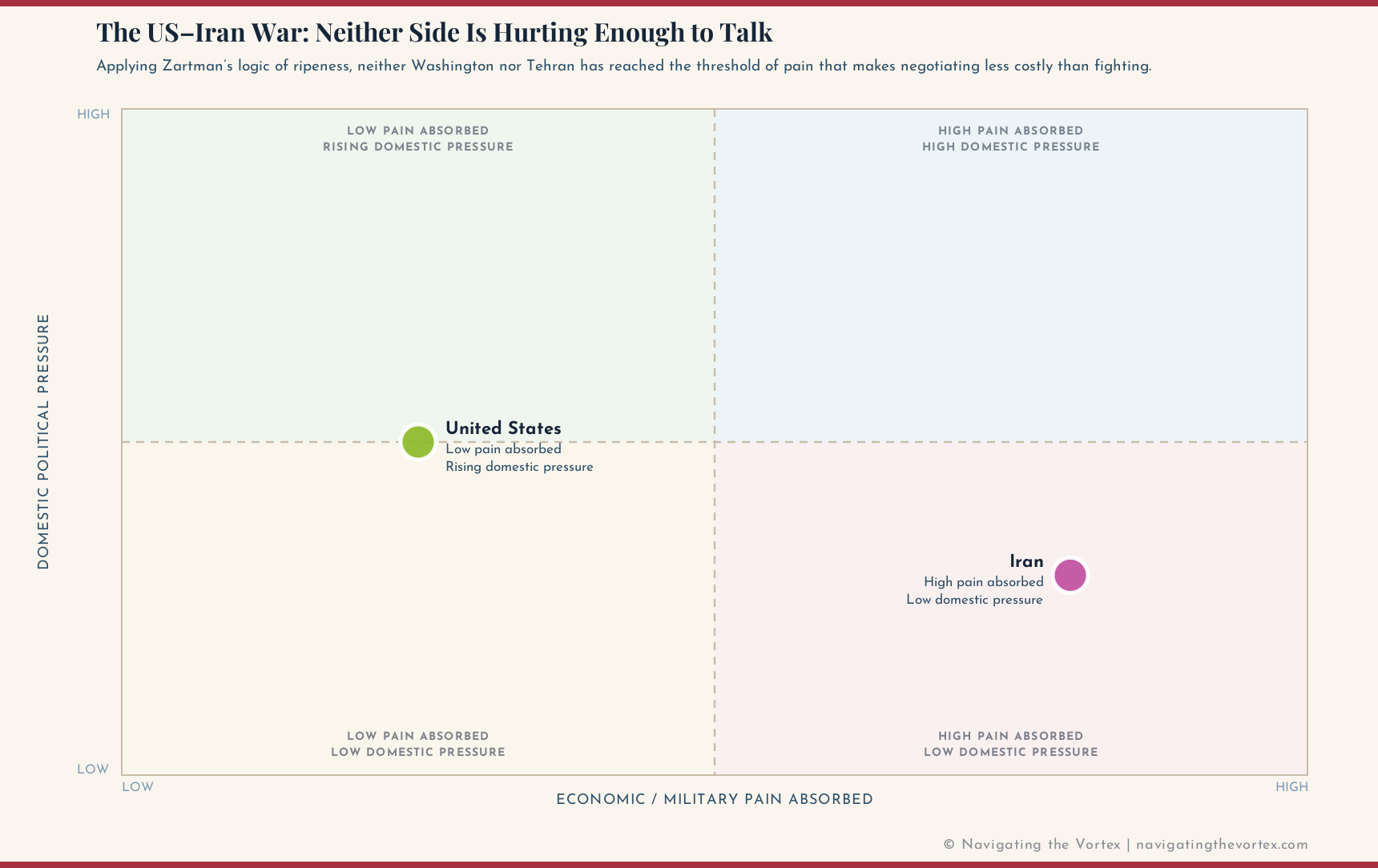
This crucial first condition has not been met: the moment when both sides perceive a mutually hurting stalemate has not yet arrived.
Iran: absorbing pain, but not changing course
Iran’s economy is under severe pressure. Oil exports have been further curtailed, the rial has sharply depreciated, and civilian discontent is palpable. But the Islamic Republic’s decision-making structure insulates the leadership from that discontent in ways that most democratic governments cannot replicate. The Revolutionary Guards retain operational autonomy and military capacity. This means they can keep the Strait of Hormuz closed and effectively supress internal dissent.
Iran cannot win militarily, but it will be reluctant to give up the power it now wields in the Strait of Hormuz, even as the negative consequences of its closure for the global economy grow each day and will take longer and longer to unwind once the war ends.
The Supreme Leader’s office continues to frame the conflict in civilisational terms that make concessions politically costly. Reframing the regime’s approach would have reputational and material costs among regime supporters at home and allies abroad. This locks the current leadership into its maximalist position and at the same time marginalises anyone inside the regime arguing for a change of course.
Mr Araghchi’s visit to St Petersburg also indicates that Iran is not as isolated as could have been expected. China has been less forthcoming with the kind of political support that Russia has just provided, but if Beijing is putting any pressure on Tehran to re-enter into negotiations with Washington, it has been doing so very quietly — and not very effectively so far.
The regime in Tehran is absorbing pain but without the need — or opportunity — to translate it into a political imperative to negotiate. Until the pain impacts the leadership’s own survival calculus, the likelihood of Iran re-engaging in serious talks remains remote.
“Sanctions, a blockade of Iranian ports, targeted strikes against regime and civilian infrastructure have already imposed real costs and will keep doing so if maintained or resumed. But costs and red lines are not the same thing.”
The United States: rising costs, no course correction
The United States is not suffering military casualties at a scale that would trigger domestic political pressure for withdrawal or raise doubt about the sustainability of military operations — a blockade of Iranian ports for now, the resumption of all-out war possibly in the future.
However, the economic costs of the conflict are accumulating in ways the Trump administration cannot ignore indefinitely: oil prices remain elevated, the mid-term electoral arithmetic is beginning to concentrate minds, and allies in the Gulf are quietly signalling alarm about both indefinite limbo and possible re-escalation.
Trump’s negotiating instincts are well documented. He prefers a deal he can brand as an unprecedented win of historic proportions to a prolonged military campaign he cannot easily conclude. But that preference has not yet overcome the institutional and political barriers to opening even a credible back-channel. The administration’s stated preconditions remain maximalist, and Iran has shown no willingness to accept them.
What’s more, the calculations in Washington are highly personalised and not always completely rational. In particular, Mr Trump’s obsession with getting a better nuclear deal than former President Barack Obama is not helpful. The 2015 Joint Comprehensive Plan of Action (JCPOA) was far from perfect, but, according to successive reports from the IAEA, most of the highly enriched uranium that justified concerns about Iranian intentions was produced after Mr Trump pulled out of the deal in 2018.
Given the deep mistrust of Mr Trump in Iran, it is unlikely that the regime will agree to his tough conditions on its nuclear programme. But mistrust is mutual, and the White House is right to be suspicious of Iran’s suggestion to decouple nuclear talks from a ceasefire and the reopening of the Strait of Hormuz. This does not indicate that Iran would be entering talks in good faith either.
What would have to change (and why it likely will not anytime soon)
For a mutually hurting stalemate to materialise, both sides would need to cross their pain threshold. And they would need to recognise this and the fact that the pain will not go away by continuing to fight.
On the Iranian side, that means either an economic collapse, escalating domestic turmoil, or a significant military setback. Any of these, and especially if they occur simultaneously, could trigger an internal political shift that elevates the cost of the war above the cost of making concessions and induces a course correction.
On the American side, it means a domestic political environment in which a deal — even an imperfect one — becomes more attractive than an open-ended commitment.
Importantly, the war, even if it resumes, will not produce a military stalemate in the classic sense, because the United States retains overwhelming military, including air superiority. This will likely create an impression on the American side that the US can still meaningfully escalate and impose a settlement on Iran. But this is an illusion.
The political cost of escalation — such as an overt threat, let alone use, of tactical nuclear strikes against Iran — is almost inconceivable, even for Trump. Anything else would not produce a decisive political outcome, at least not quickly. Sanctions, a blockade of Iranian ports, targeted strikes against regime and civilian infrastructure have already imposed real costs and will keep doing so if maintained or resumed. But costs and red lines are not the same thing. Until both sides reach their red lines, the conditions for a genuine negotiation — rather than tactical manoeuvring and public positioning — do not exist.
The risk of escalation
What is more worrying than the continuation of a low-intensity conflict with no incentives for either side to talk is the alternative — renewed escalation.
The US has continued building up resources in the Middle East over the last two-and-a-half weeks since the initial temporary truce agreed between Washington and Tehran. It has deployed a third aircraft carrier to the Middle East, the USS George HW Bush.
Amassing such unprecedented firepower in the region is likely intended to send a signal of strength and resolve to Tehran: a full-scale resumption of the war remains available as an option to Mr Trump, who has repeatedly threatened such a move.
It would not be the first time that Mr Trump has used the ruse of actual or potential negotiations to lure Tehran into a false sense of security before pouncing again. Further escalation, or even a credible threat thereof, might therefore qualify as what Zartman described as an impending, past, or recently avoided catastrophe and which he considered as contributing to a ripe moment because it focuses the parties’ minds on the possibility of increased pain.
The problem in the Iran context, however, is that for all his bravado, Mr Trump’s shifting ultimatums suggest a reluctance to follow through. This may be a sign that he realises military escalation offers no clear path to victory — an insight that will not have been lost on the regime in Tehran either.
Neither side, thus, has found a winning strategy, but they have found a strategy of not losing. As a consequence of the resulting ambiguity of this continuing state of limbo in which they therefore find themselves the conflict will likely persist even once it has ceased to serve the strategic interests of either side.
“The conditions for a genuine negotiation do not yet exist — and identifying why is the first step to understanding when they might.”
This analysis draws on Stefan Wolff’s article published in Channel News Asia on 29 April 2026.
At what point does the domestic political cost of continuing the war exceed the political cost of the concessions required to end it — and which side reaches that threshold first?
You can also listen to the Navigating the Vortex podcast — 87 episodes on Apple Podcasts, Spotify, and Amazon Music. New episodes when the news demands it.