




Hot on the heels of his summit with US president Donald Trump, China’s Xi Jinping hosted his Russian counterpart, Vladimir Putin, in Beijing on May 19 and 20.
Headlines spoke of multiple trade agreements, warnings against a return to the law of the jungle in international relations, and a joint declaration on building a multipolar world. But underneath that, it was also obvious that this is not a partnership of equals anymore – and hasn’t been for some time.
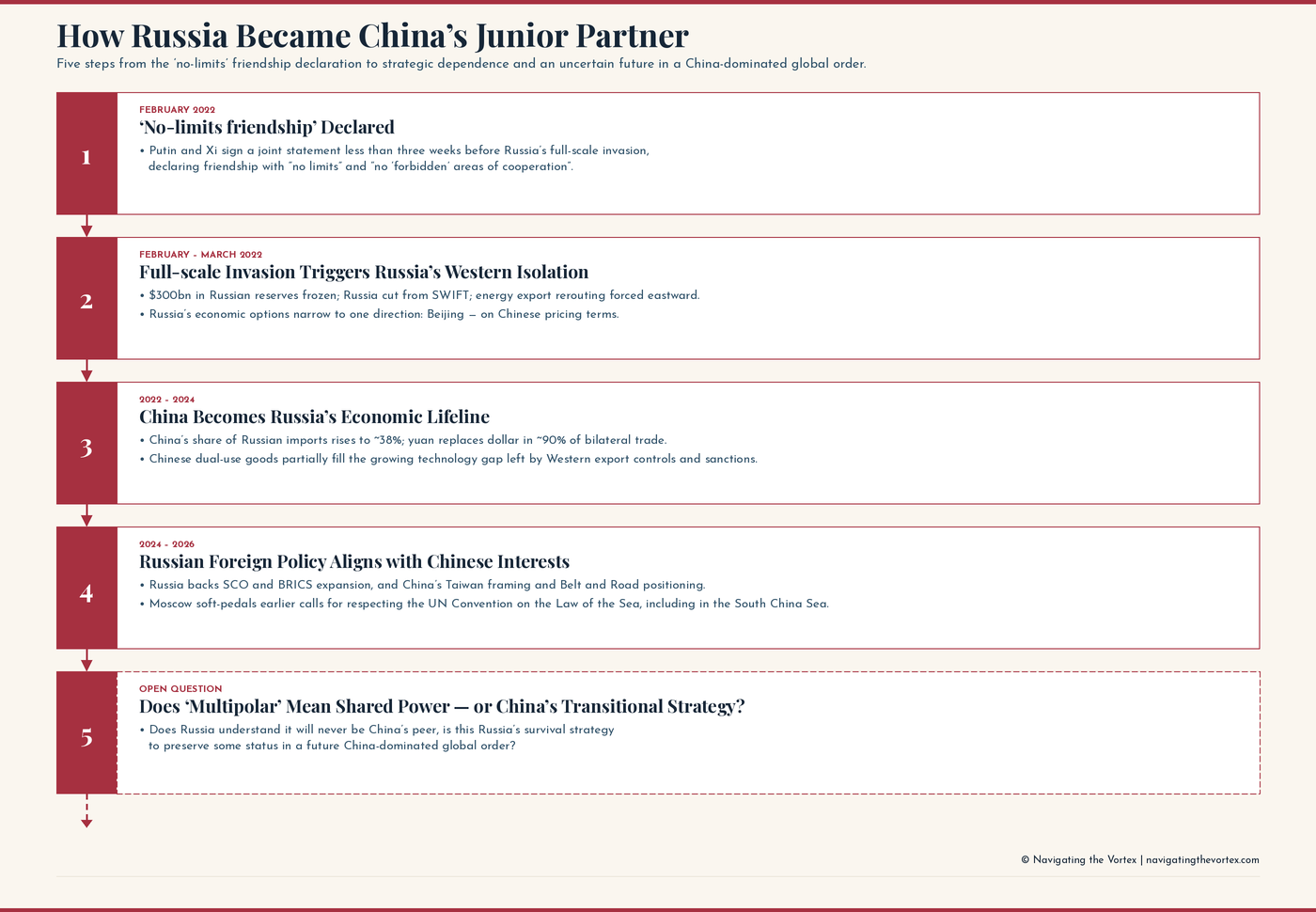
Since Russia’s full-scale invasion of Ukraine in February 2022, Russia has become increasingly dependent on China. But the 2022 proclamation of a “no-limits friendship” between Russia and China has not turned into a strategic alliance between two poles of a new world order.
Beijing is now Moscow’s most important export market for its oil and gas and its most important source of imports, especially of so-called dual-use goods that are critical to sustaining Russia’s war effort against Ukraine. Yet, bilateral trade between Russia and China, while consistently above US$200 billion (£149 billion) annually for the past three years, is not growing that fast.
Notably, Russia is one of the few countries with which China has a trade deficit, albeit a small one, driven by Chinese energy imports. In this context, the continuing lack of a final deal between Moscow and Beijing over the Power of Siberia 2 gas pipeline is remarkable but not surprising. The key disagreements appear to be on price (how much China pays) and volume (how much China buys), and potentially over the length of any such commitments.
China is reluctant to commit fully to a long-term and expensive partnership with Russia. China wants Russian gas, but not at any price.
This sheds an interesting light on Beijing’s strategic commitments to Moscow, indicating that China is reluctant to commit fully to a long-term and expensive partnership with Russia. China wants Russian gas, but not at any price.
Beyond their economic relations, China also provides critical political and diplomatic cover for Russia in various multilateral formats and helps Russia retain its reputation as a champion of concerns of the global south and as a critic of a US-dominated global order. This is unlikely to change, with Xi explicitly committing himself and Putin to “continue to offer each other firm and mutual support on matters relating to our respective core interests and key concerns”.
All roads lead to Beijing
Putin is the 12th leader to visit Xi this year. He has followed in the footsteps of, among others, Canada’s Mark Carney, the UK’s Keir Starmer, and Germany’s Friedrich Merz. And, of course, his visit followed just a week after Xi’s summit with Trump. This makes Beijing clearly an important pole in a multipolar order — and a more important one than Moscow.
For Russia, a multipolar order in which Moscow is one of the poles, is probably the best that the Kremlin can hope for.
There is clearly significant ideological alignment between Russia and China, including in their sometimes more veiled and sometimes more explicit criticism of the US. But their shared criticism of US hegemony and unilateralism disguises a crucial difference over what they envision as the end state of the current transition to a new order.
For Russia, a multipolar order in which Moscow is one of the poles, is probably the best that the Kremlin can hope for. For Beijing, the real issue is whether a multipolar order is simply a transitional phase — and the desired endpoint is instead Chinese hegemony. This would place China at the apex with all the other poles of the multipolar order, including Russia and the US, relegated to second-tier status.
The challenge for China in this context is how to avoid all-out confrontation with the US — the so-called Thucydides Trap, which refers to the near inevitability of war between a rising power (in this case, China) and the existing dominant power (in this case, the US) it seeks to replace.
For now, war between the US and China is not imminently in the cards. Instead, China and Russia can exploit an opportunity grounded in their shared dislike of a US-dominated world and facilitated by Trump’s active destruction of it. But not much of this has so far translated into a coordinated and effective foreign policy agenda, despite Putin’s and Xi’s rhetorical commitments.
Where Russia sees an opening for disruption and chaos, China senses an opportunity to accelerate the transition to Chinese dominance.
Two of the multilateral flagship projects of China and Russia, the Shanghai Cooperation Organisation (SCO) and the BRICS are not coherent formats. India and Pakistan are members of the SCO and yet fought a war in 2025. Iran and the UAE are both part of the newly enlarged BRICS but now find themselves at opposite sides of the US-Iran war.
Regardless of how effective the challenges to the existing international are — from Trump and from the disparate bloc led by China (and to some extent still Russia) — they are real and create space for China and Russia to pursue their own agendas. And this is another crucial difference: where Russia sees an opening for disruption and chaos, China senses an opportunity to accelerate the transition to Chinese dominance.
The clear signal from the Xi-Trump and Xi-Putin summits is that China is not choosing between Russia and the US. This underscores Xi’s rhetorical commitment to a multipolar order. It also indicates that China keeps instrumentalising Russia and the US. Russia is a useful partner — not an ally, and not a vassal yet. The US, meanwhile, is an essential political and economic partner — an equal for now, but not forever.
This gives reassurance to Russia that, for now, China sees a multilateral order as beneficial, while signalling to the US that China, again just for now, is not seeking to replace the US as the sole superpower.
But neither Moscow nor Washington should be under any illusion that a tripolar order is China’s ultimate goal. This is a transitional strategy to a China-dominated international order through which Beijing hopes to avoid the Thucydides Trap.
This analysis draws on Stefan Wolff’s article published in The Conversation on 21 May 2026.
If China’s multipolar rhetoric is a transitional strategy toward primacy rather than a settled end state — as this analysis argues — at what point does Moscow recognise it has become a tool of Beijing’s grand strategy rather than a partner, and what leverage, if any, does Russia retain to resist that trajectory?
We hope you’ll share Navigating the Vortex with anyone you think might find it of interest. Also, you can listen to our podcast editions via the website and on all major podcast platforms, including Apple Podcasts, Spotify, and Amazon/Audible.