




The AI Frame War — Part 4 of 4
This is Part 4 of The AI Frame War, a four-part PDQ series. Part 1 mapped where major governments stand after June 2026’s pivotal moves — and identified Colorado’s AI Act as the most rights-protective operative framework in the US. Part 2 examined the two models competing for the world’s uncommitted governments, and described Colorado as holding the rights line inside a country whose federal government was moving in the opposite direction. Part 3 used Canada as the clearest case study in how a democracy makes that choice under pressure — and chose growth over rights. This fourth piece covers the American exception that no longer exists. Each piece stands on its own; read together they map the AI frame war — and how the terrain shifted in one defining month.
On 14 May 2026, Governor Jared Polis signed SB 26-189, which repeals Colorado’s original AI Act and replaces it with a disclosure-based framework that contains none of the rights-protective mechanisms the original law was built around. The rights-frame exception inside US federal AI policy — the thread this series identified as the most consequential internal contradiction in American AI governance — is gone. What follows is not an account of how Colorado was defeated in court. It is an account of how Colorado made a political choice, what drove that choice, and what it tells every board about the structural resilience of rights-based AI governance when it faces organised pressure.
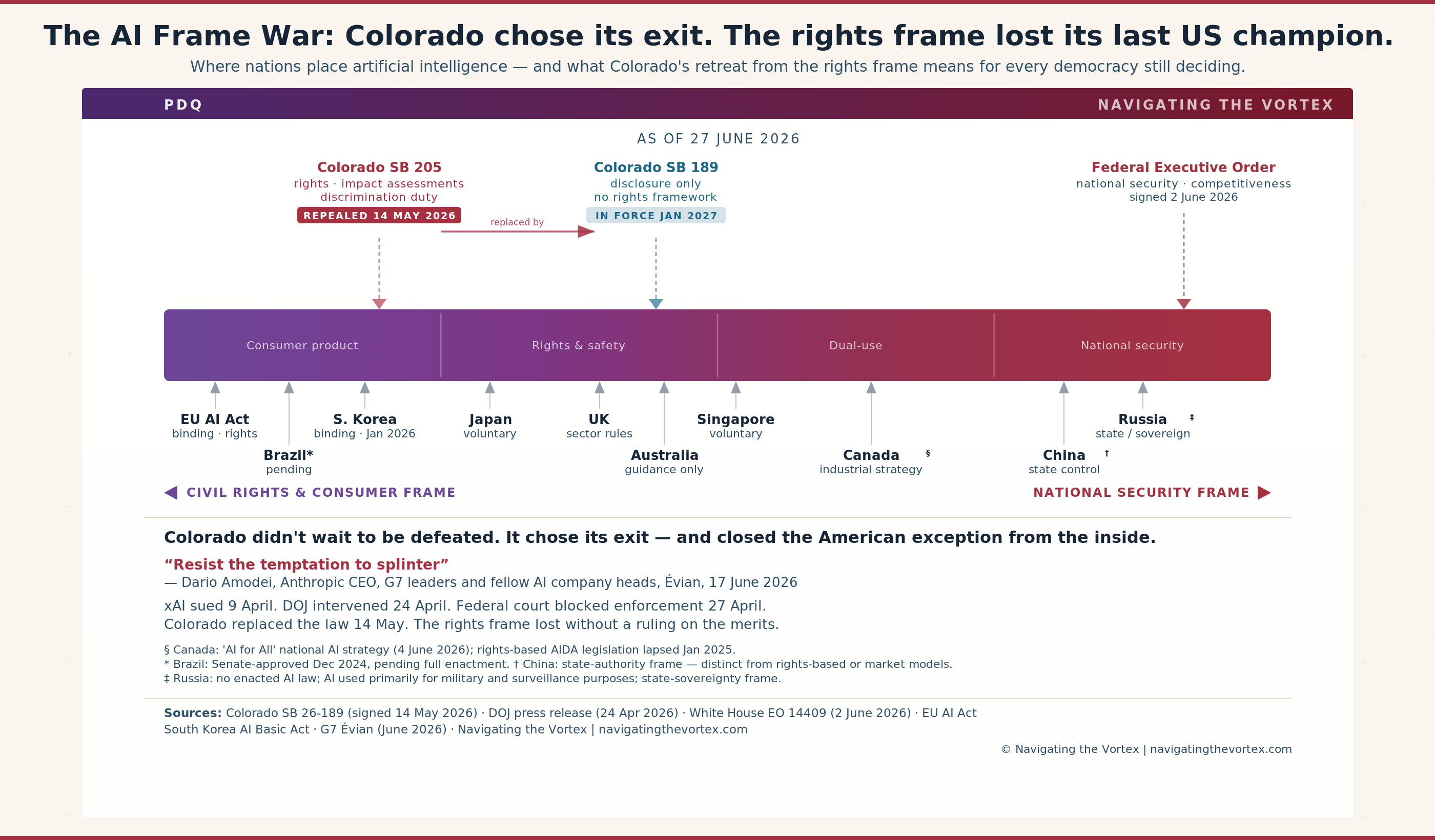
1. Colorado didn’t wait to be defeated — it chose its exit.
The sequence matters. On 9 April 2026, xAI filed a federal lawsuit challenging SB 205 on constitutional grounds. On 24 April, the Department of Justice intervened to support xAI’s position, arguing SB 205’s disclosure requirements constituted compelled speech and its algorithmic discrimination provisions imposed impermissible race- and sex-conscious obligations. On 27 April, a federal magistrate blocked enforcement of SB 205. Colorado’s legislature introduced a replacement bill on 1 May. Polis signed it thirteen days later. The court never ruled on the substantive constitutional questions. Colorado moved before it had to.
Governor Polis had flagged concerns about SB 205 before the lawsuit existed. When the lawsuit, DOJ backing, and a court order arrived simultaneously, the political cost of defending the law crystallised — and turned out higher than the political cost of replacing it. The federal apparatus did not need to win in court. It needed to make the political calculation clear, and Colorado did the rest.
For boards and governance teams: the lesson is not that rights frameworks cannot survive litigation. It is that a rights framework survives only if the political cost of abandoning it is higher than the political cost of defending it. That threshold is set by how deeply entrenched the framework is — and Colorado’s SB 205, a statute eighteen months old, contested from both industry and civil society, never yet enforced, did not clear it.
2. Formal preemption was never needed — the mechanism is the message.
The Trump administration’s strategy was explicit from its December 2025 executive order: challenge conflicting state AI laws through litigation, develop a preemptive national framework, treat strong state governance as regulatory friction. That strategy did not require Congress to pass preemption legislation. It required one lawsuit from a well-resourced company, DOJ backing, and a court order. Colorado supplied the rest.
The White House’s March 2026 National Policy Framework for AI recommended that Congress broadly preempt state AI laws deemed to impose “undue burdens.” Congress has not acted. It didn’t need to. The informal preemption — executive order, lawsuit, DOJ intervention, court block, replacement legislation — produced the same result without a single vote on Capitol Hill.
What this means for any jurisdiction watching: a rights framework that has not passed into deep institutional structures — enforcement infrastructure, board-level compliance obligations, political constituencies whose interests are now bound to the framework — is vulnerable to exactly this sequence. The EU AI Act has survived because unwinding it is more expensive than complying with it. That pressure from economic competitiveness agendas is real — but the EU AI Act has passed the point where economic argument alone can reverse it: enforcement infrastructure, compliance investment, and political constituencies are already embedded. A state statute facing its first lawsuit, with an unenthusiastic governor and an organised federal opposition, does not enjoy that protection.
3. Canada and Colorado reached the same destination by different routes.
Part 3 of this series documented how Canada abandoned AIDA — a rights-based AI bill cleared for committee passage — under three structural forces: economic lag, US-alignment pressure, and legislative convenience. No democratic vote against rights governance. No constitutional defeat. A political mechanism — prorogation — resolved it without requiring either side to win the argument.
Colorado’s route was different: executive order, lawsuit, DOJ intervention, court block, replacement statute. But the destination is identical. Both jurisdictions had rights-based AI frameworks. Both chose lighter alternatives before those frameworks took full legal effect. Neither required a democratic mandate against the rights approach — both were resolved through political mechanisms that bypassed the contest the rights frame needed in order to win.
Read Canada not as a country that changed its mind, and Colorado not as a state that lost a legal fight. Read both as case studies in the structural conditions under which rights-based AI governance fails to entrench before pressure arrives. Those conditions — economic exposure, US-alignment pressure, frameworks that have not hardened into institutional infrastructure — are present in more than a dozen other democracies. The pattern is not coincidental. It is the operating logic of the industrial frame.
4. The US has defaulted to the industrial frame — what that means for your organisation.
SB 26-189, which Polis signed on 14 May, takes effect 1 January 2027. It contains disclosure requirements and consumer notification rights for automated decision-making technology. It does not contain risk tiers, mandatory impact assessments, algorithmic discrimination duties, or enforcement provisions comparable to the original Act. As of today, there is no operative state AI rights framework in the United States. The Federal Executive Order of 2 June 2026 — “Promoting Advanced Artificial Intelligence Innovation and Security,” EO 14409 — establishes voluntary benchmarking frameworks for frontier AI models and prioritises cybersecurity measures. Voluntary. No mandatory impact assessments. No consumer rights of appeal. No board-level accountability obligations.
For organisations that have been building AI governance to Colorado’s standard for US market coverage: that standard no longer exists in the form you were building to. The floor you were planning around has been replaced by a disclosure obligation that takes effect in six months.
The practical implication is clear: if you are building AI governance to protect your organisation’s position across markets, the relevant rights-framework standards are the EU AI Act, South Korea’s AI Basic Act (in force January 2026), and — for certain sectors like financial services and healthcare — UK and Australian frameworks. If you have built to those standards, you are ahead. The “build to the strictest applicable standard” default that Part 2 of this series identified as the pragmatic corporate position now has an unambiguous answer in the US context: the strictest US standard is the EU AI Act, applicable to any system making consequential decisions about people in EU markets.
5. The contest is not over — but which rights frameworks are robust enough to plan around has become a more specific question.
Neither Canada nor Colorado represent the end of the rights frame’s prospects. South Korea’s AI Basic Act took effect January 2026 and covers a genuinely competitive AI economy — proof that the rights model can take root and hold outside Europe. Brazil’s AI legislation remains in progress. The EU AI Act is generating enforcement activity and compliance infrastructure across markets. The democratic rights coalition is smaller than it was in June — but it has not disappeared.
What has changed is the answer to a precise question: which rights frameworks are structurally robust enough so that you can plan your governance around them for the next five years? The evidence from the last six weeks suggests the answer requires two conditions. First, deep institutional entrenchment: not just statutory text, but enforcement infrastructure, board-level compliance structures, and political constituencies whose interests are now bound to the framework’s survival. Second, insulation from the three structural forces Part 3 named — economic lag, US-alignment pressure, and legislative convenience — which together make the political cost of abandonment lower than the political cost of defence.
On those two tests, the EU AI Act and South Korea pass. Canada’s AIDA and Colorado’s SB 205 did not. For boards making AI governance investment decisions now: that is the distinction to apply to every jurisdiction in your operating footprint. Not “is there a rights-based law in progress?” but “has it hardened into the kind of institutional structure that survives a well-funded legal challenge and an unsympathetic federal government?” If the answer is no — plan for the floor to move, and build above it regardless. A governance framework built only to the statutory minimum, without institutional depth, does not hold — as Colorado just demonstrated.
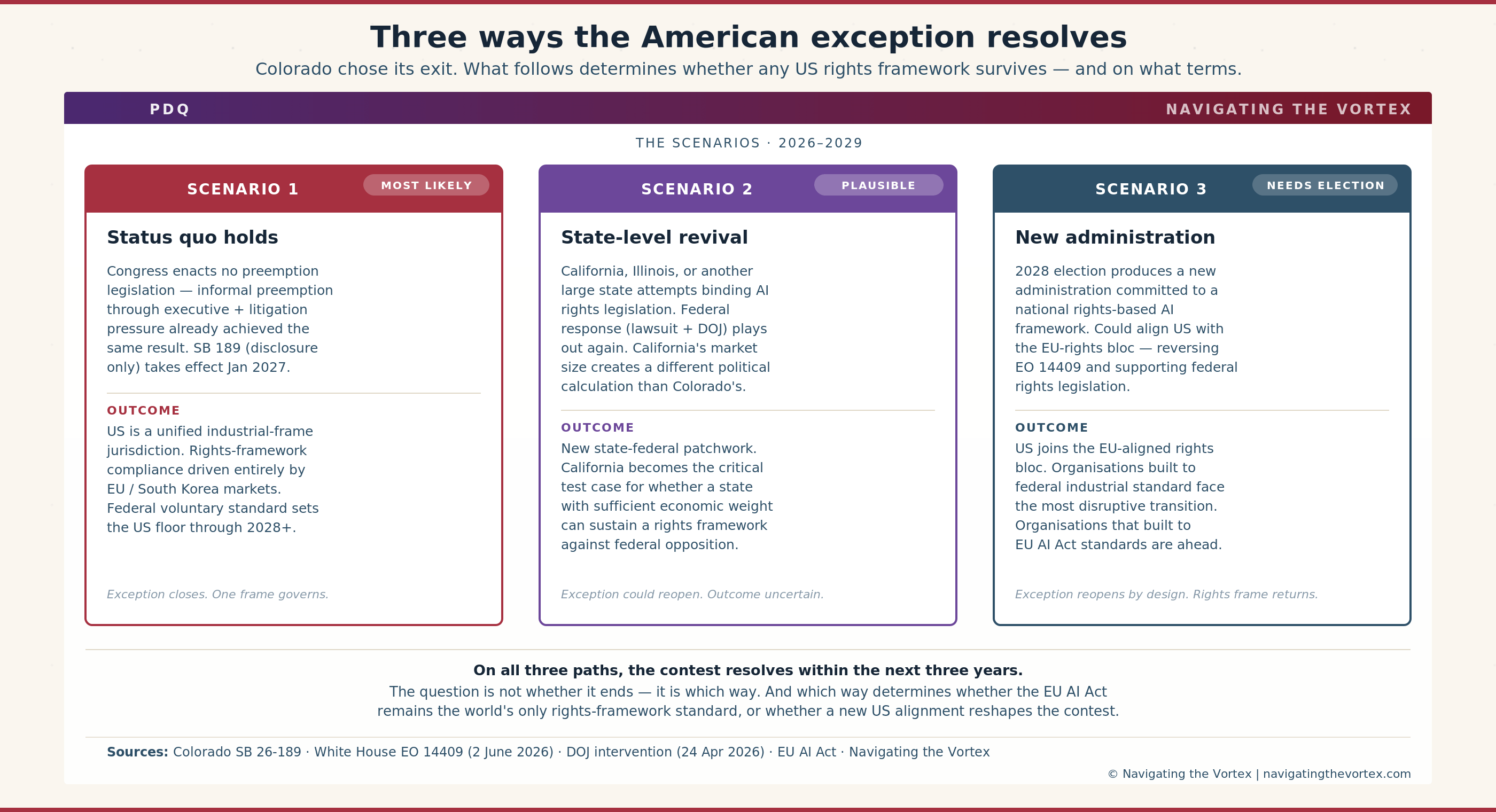
Four articles. Four moves. One month that redrew AI governance.
Part 1 mapped the split: two AI governance frames both operative in June 2026, the world’s governments dividing between them, no global standard yet settled. Part 2 showed what the two models mean for every organisation — the fiduciary bet every board is already making, whether it knows it or not. Part 3 showed how Canada, under economic pressure and US-alignment pull, chose the industrial frame over a rights bill that had cleared committee — and named the three structural forces that made abandonment the rational political choice. This fourth piece shows how Colorado made the same choice by a different mechanism: not prorogation and legislative lapse, but a well-funded corporate lawsuit, a DOJ intervention, a court order, and thirteen days of legislative action.
The pattern across all four is the same: rights frameworks that are not deeply institutionally entrenched do not survive sustained pressure. Canada’s bill died in committee; Colorado’s act lasted months before organised federal and corporate opposition replaced it. What survived — the EU AI Act, South Korea’s AI Basic Act — did so because those frameworks have reached the stage where abandonment is no longer cheap. They have generated compliance infrastructure, enforcement expectations, board-level accountability, and political constituencies whose interests are now bound to the framework’s survival. The cost of unwinding them is higher than the cost of complying with them. That is what entrenchment means in practice.
The rights frame did not lose the AI governance contest in June 2026. It lost two of its most visible champions, in two different countries, in four weeks, through two different mechanisms. That is not the same thing as losing the contest. The contest remains open. But the field is smaller — and the lesson of what just happened is precise: in the AI frame war, the question is never just which framework your jurisdiction has adopted. It is whether that framework is built to survive the pressure that arrives when the stakes get high enough. On current evidence, there are two answers to that question. Build to the EU AI Act and South Korea standards. Everything else is provisional.
Which of the two survival conditions — deep institutional entrenchment, or insulation from the three structural forces this series named (economic lag, US-alignment pressure, and legislative convenience) — is harder to achieve in the jurisdictions your organisation operates in? And does your board’s AI governance strategy account for the possibility that the floor moves before it takes full effect?
That is The AI Frame War — the map, the models, the pivot, the choice. Four pieces that together trace how the structure of the AI governance contest shifted more in one month than in the two years before it. We hope you will read it, share it with colleagues, and that it helps guide your thinking when addressing these issues.
This series is free. Subscribe at navigatingthevortex.com — and get the story before the consensus forms.