




The world’s AI-regulation map shifted more in June 2026 than in the prior two years combined — and the divide it now shows will shape every government, organisation and board’s decision-making.
The AI Frame War — Part 1 of 4
This is Part 1 of The AI Frame War, a four-part series publishing Tuesday through Friday this week. Part 2 (tomorrow) examines two models now in direct competition for the world’s AI rules. Part 3 (Thursday) uses Canada as a case study for the choice every democracy will face. Part 4 (Friday) covers the American exception — Colorado’s AI Act vs. federal policy. Each piece stands on its own; together they map the AI frame war.
In one momentous month, governments around the world are dividing between two futures for AI — one where it is a right to be protected, one where it is a strategic asset to be deployed. June 2026 made three of those choices visible.
Since 2 June 2026, three governments have set their positions. The US federal government signed a Federal Executive Order framing AI as a national-security and competitiveness asset; Colorado’s AI Act — the first US state law requiring companies to protect consumers from high-stakes AI decisions — takes effect on 30 June, six days from now; and Canada shelved its rights-based bill on 4 June in favour of a $2.3 billion industrial strategy.
The G7 met in Évian (15–17 June) and produced no common AI governance framework. The summit communiqué’s AI section covers protection for children from chatbots and a pledge to accelerate ‘safe and beneficial deployment’ — language broad enough to contain both the rights frame and the industrial frame simultaneously, and therefore settles nothing. Seven governments. One communiqué. No answer to the question this series asks.
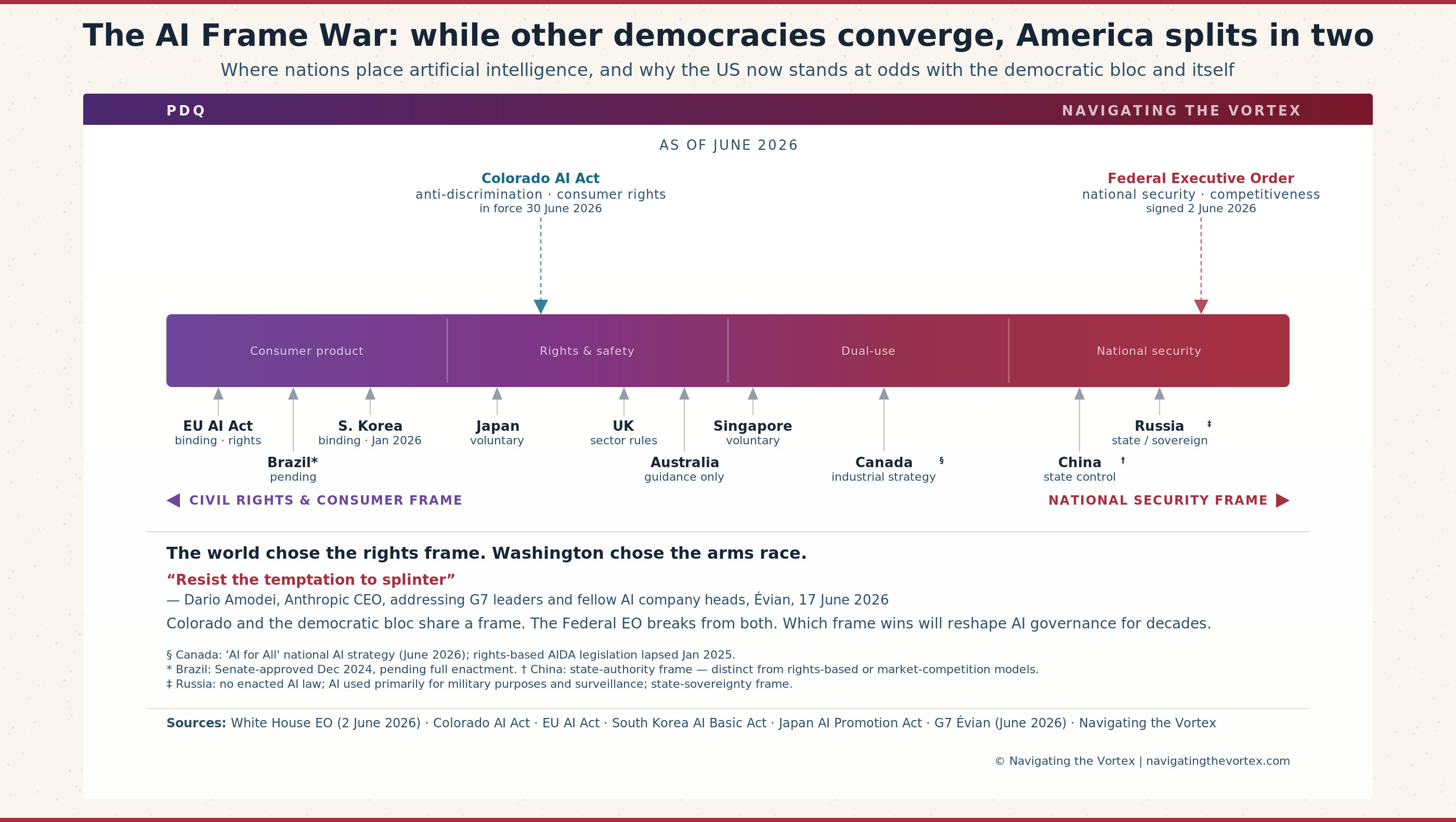
How the map is drawn: each jurisdiction’s position on the horizontal axis reflects three factors — the stated primary purpose of the law or strategy (rights protection vs economic development vs state authority); the degree of binding legal obligation; and alignment with international frameworks such as the EU AI Act and the OECD AI Principles. Left of centre on the axis = rights or risk protection is the primary purpose; right of centre = industrial promotion or strategic advantage.
1. The map changed, not the territory. In June 2026, intent became law. Three governments committed their AI frames to statute or official national strategy this month — and the frame a government chooses shapes every regulation, procurement decision, and board agenda that follows. The territory did not change: AI’s capabilities, risks, and economic potential are what they were in May. What changed is the map — the legal and political framework governments use to define what AI governance is for. A government that has classified AI as a national-security and competitiveness asset will not later write a rights-based statute. Read the frame and the downstream laws become predictable.
2. Canada is the canary. A G7 democracy with deep EU ties had a rights-based law ready, let it die, and chose growth. This is not simply a Canadian story — it is the template every democracy under adoption pressure now faces.
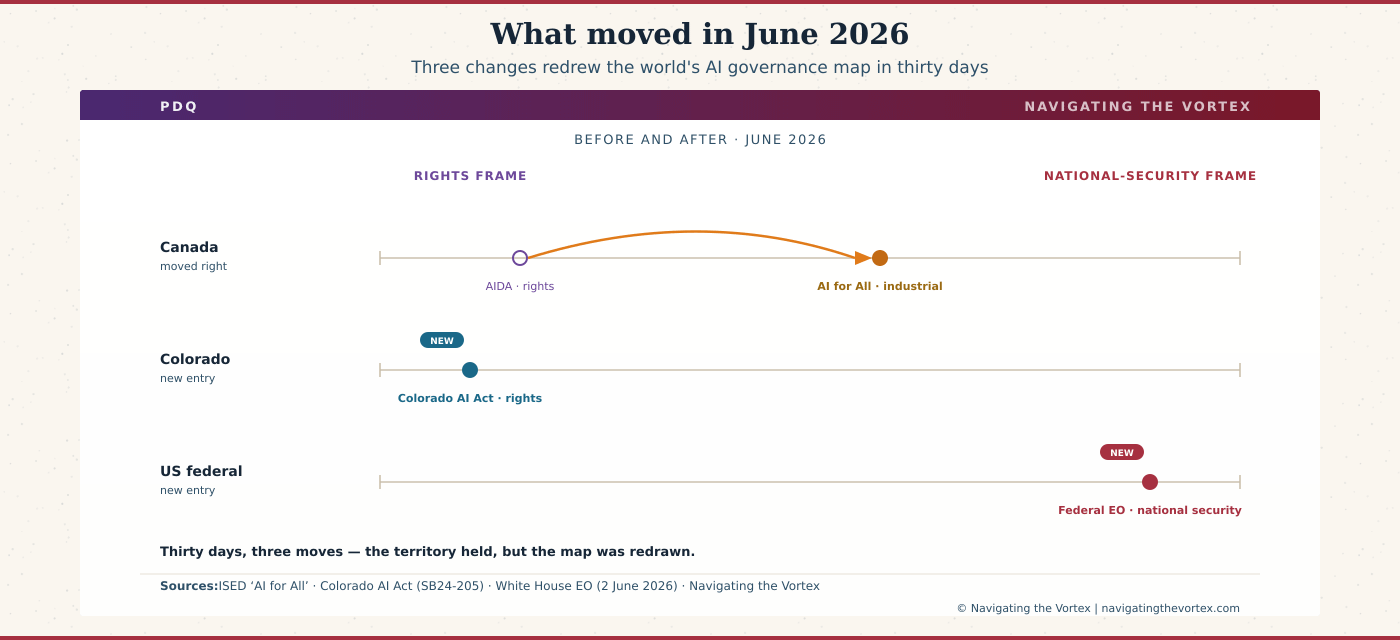
3. The US is not one country on AI. The Federal Executive Order and the Colorado Act rest on incompatible theories of what AI is: the Executive Order treats it as a national asset to be deployed without constraint; Colorado’s law treats it as a potential threat to citizens that must be regulated to protect rights, and both are now operative. This is now a contradiction embedded in law, not a policy disagreement on its way to committee resolution. For any organisation operating in the US market, this is not abstract. Colorado’s law takes effect in six days. There is no reconciliation mechanism — boards must satisfy both frameworks simultaneously, make a legal bet on which will survive, or build to both at additional cost. For boards outside the US: if you serve US consumers, Colorado’s obligations apply to you regardless of where you are incorporated. If you source from US vendors, check which framework they were built to — federal permissiveness does not travel.
4. The democratic convergence is real but fragile. The EU, South Korea, Japan, the UK, Brazil, Australia and now Colorado share a rights frame — the closest thing to a global standard the AI governance field has produced. A coalition, not a consensus: the member governments agree on the same rights-based outcome but for different underlying reasons and with different levels of commitment. A true consensus would mean internalising a shared principle — much harder to defect from. Canada just showed how fast a coalition member leaves when growth pressure and US-alignment pull the same way.
5. For a board, this map is a planning document, not a curiosity. Where your jurisdictions sit determines which compliance regime your AI roadmap is being built inside this year. The next move to watch: which democracy outside the EU-US axis recalculates after Canada — and whether the US split deepens — more states passing their own rights-based AI laws, or the ideological divide between federal and state frameworks hardening — or is blocked by federal law asserting constitutional supremacy over state AI regulation.
The question isn’t whether democracies converge on a rights frame. It’s how many defect before the rights-frame coalition hardens into a standard — and Canada just showed the price of leaving is lower than it looked. Watch who recalculates next.
Tomorrow — Part 2: Two Incompatible Models for AI Are Competing for Global Dominance. The EU and the US are running fundamentally different AI-regulation models; every country, organisation and board is already inside one of them — whether they know it or not.
This series is free. Subscribe at navigatingthevortex.com — and get the story before the consensus forms.