




The AI Frame War — Part 3 of 4
This is Part 3 of The AI Frame War, a four-part Navigating the Vortex PDQ series. Part 1 mapped where governments stand after June 2026’s pivotal moves. Part 2 examined the two models now in direct contest for the world’s uncommitted governments. This piece shows how one democracy made that choice in real time — and what the sequence reveals about how every democracy will have to make that choice. Part 4 (tomorrow) covers the American exception: Colorado’s AI Act vs. the federal Executive Order. Each piece stands on its own; read together they map the AI frame war.
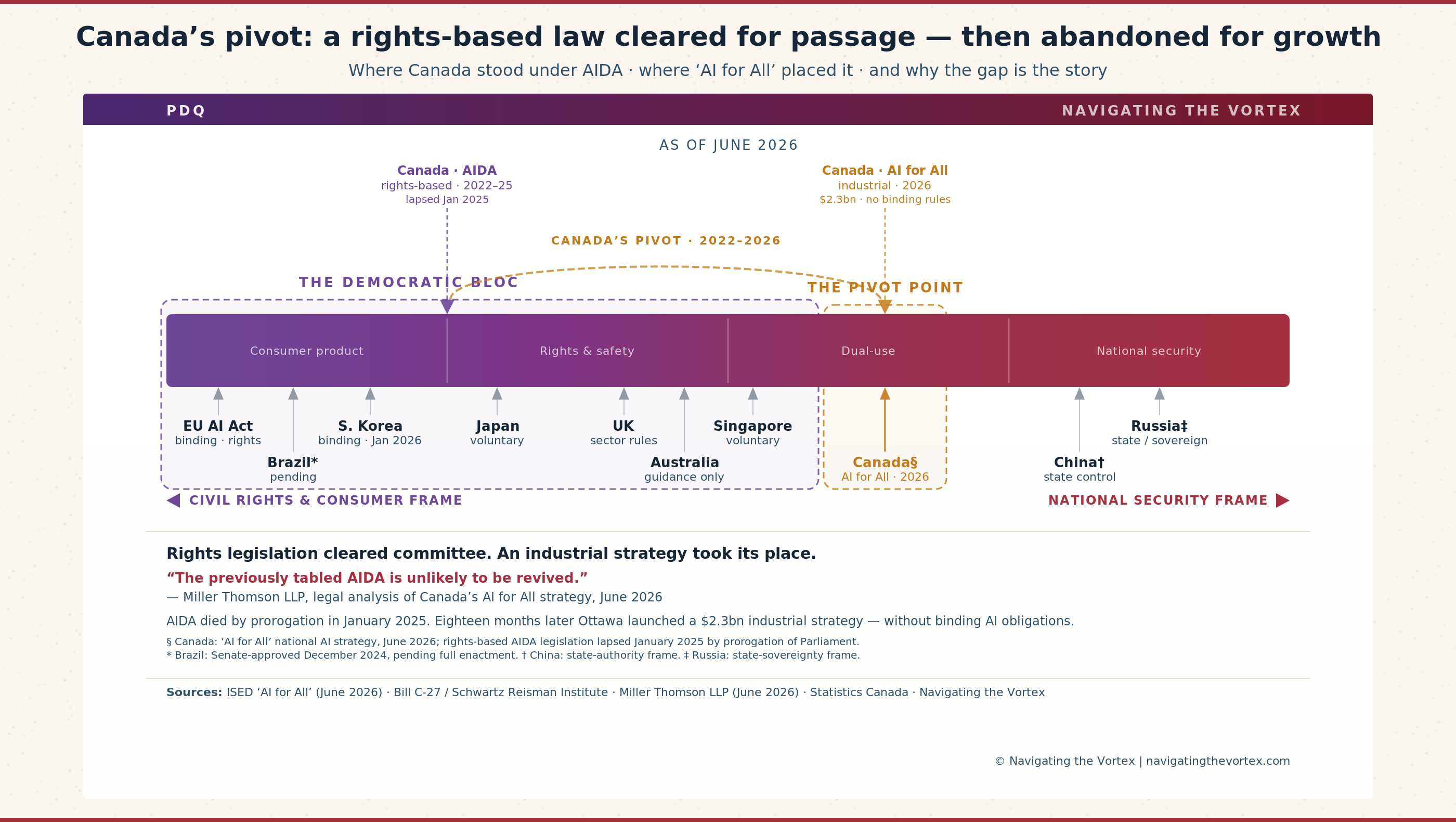
On 4 June 2026, Prime Minister Mark Carney launched ‘AI for All’, Canada’s new national artificial intelligence strategy. The $2.3 billion industrial plan targets a lift in AI adoption from just over 12% of businesses — below the OECD average — to 60% by 2034. What AI for All does not contain is binding AI legislation. The Artificial Intelligence and Data Act — AIDA — which had cleared committee in Parliament, will not be revived. The rights frame was not defeated. It was abandoned. And the three forces that drove that abandonment — economic lag, US-alignment pressure, and legislative convenience — are present in more than a dozen other democracies right now.
Parts 1 and 2 of this series mapped the global AI-regulation landscape and the contest between the EU’s rights model and the US industrial model. This piece uses Canada as the clearest available case study in how that choice is made in practice: what collapsed, what replaced it, and what the sequence tells every board operating outside the EU.
1. AIDA’s death was procedural, not principled — and that’s the point.
AIDA was Part III of Bill C-27, the Digital Charter Implementation Act, introduced in June 2022 alongside the Consumer Privacy Protection Act. It passed a second reading and was referred to committee in April 2023, where it remained — contested by civil society and industry alike — as Parliament worked through proposed amendments. When Prime Minister Trudeau prorogued Parliament on 6 January 2025, all pending legislation died on the order paper, including both AIDA and the accompanying privacy reform. The prorogation was triggered by a political crisis. But what it created was an opportunity — and the Carney government, elected in April 2025, chose not to restore it.
The position was confirmed after AI for All’s launch: the strategy “does not introduce comprehensive AI legislation in Canada, and confirms that such legislation is, for now, not contemplated. The previously tabled AIDA is unlikely to be revived.” The rights frame did not lose an argument. It lost a political moment, and then a political choice followed. Those are different things — and regulators in every jurisdiction that has rights-based AI legislation in its pipeline should read the distinction carefully.
2. This is a story about executive power over regulatory design.
A rights agenda that had passed out of committee was overridden by an executive reorientation. This matters beyond Canada because the mechanism is structural, not idiosyncratic: any rights commitment in AI governance is only as durable as its political entrenchment. Passed legislation is more durable than strategy; legislation hardened into institutional structures is more durable still. The EU AI Act, which is now in force and generating compliance obligations across markets, represents deep entrenchment. A bill at committee stage does not.
The Canada-United States-Mexico Agreement (CUSMA) review sharpens this point. Canada is currently renegotiating its trade relationship with the United States. In March 2026, the US Trade Representative’s annual trade estimate report named Canada’s digital sovereignty measures as trade barriers for the first time — a signal that Washington intends to treat strong AI governance as a friction to be negotiated away. Canada entered those talks without binding AI legislation. The executive that might have defended a rights framework instead launched an industrial strategy. For boards whose operating jurisdictions have AI rights legislation in progress but not yet entrenched, the Canadian sequence is a risk template: the window between ‘cleared committee’ and ‘hardened into law’ is when executive reversal costs the least.
3. Three forces drove the pivot, and none is unique to Canada.
The first is economic lag. Statistics Canada recorded that 12.2% of businesses were using AI in the second quarter of 2025 — below the OECD average, and behind the UK (20.5%) and Germany (19.75%) among its fastest-accelerating G7 peers. Canada’s own SME AI Adoption Blueprint, prepared for the G7, documented that gap and made closing it the central case for urgency. A government looking at those numbers and at a rights-based legislative framework that had attracted sustained criticism from both industry and civil society made a rational political calculation.
The second is US-alignment pressure. Canada’s trade exposure to the United States is structural — roughly 75% of Canadian exports go south. The CUSMA 2026 review was live when AI for All launched. The US Trade Representative had named Canada’s digital sovereignty measures as trade barriers three months earlier. An AI rights framework that Washington would treat as a trade friction was a harder political sell in that environment than an industrial strategy aligned with the direction the US had already set at federal level.
The third is legislative convenience. AIDA was not a standalone bill. It was packaged inside C-27 alongside the Consumer Privacy Protection Act, which had its own critics and its own contested history. Letting the whole bill die cleared a thorny legislative agenda without requiring the government to defeat either part on its merits. The political cost of abandonment was low. The political cost of revival, during a CUSMA negotiation, was considerably higher.
The combination of these three forces — economic urgency, trade-relationship alignment, and legislative convenience — is not specific to Canada’s geography, government, or political history. They are structural features of any other democracy with deep US trade exposure, a growth gap to close, and AI rights legislation that has not yet passed into law.
4. Every democracy is watching — but not from the same position.
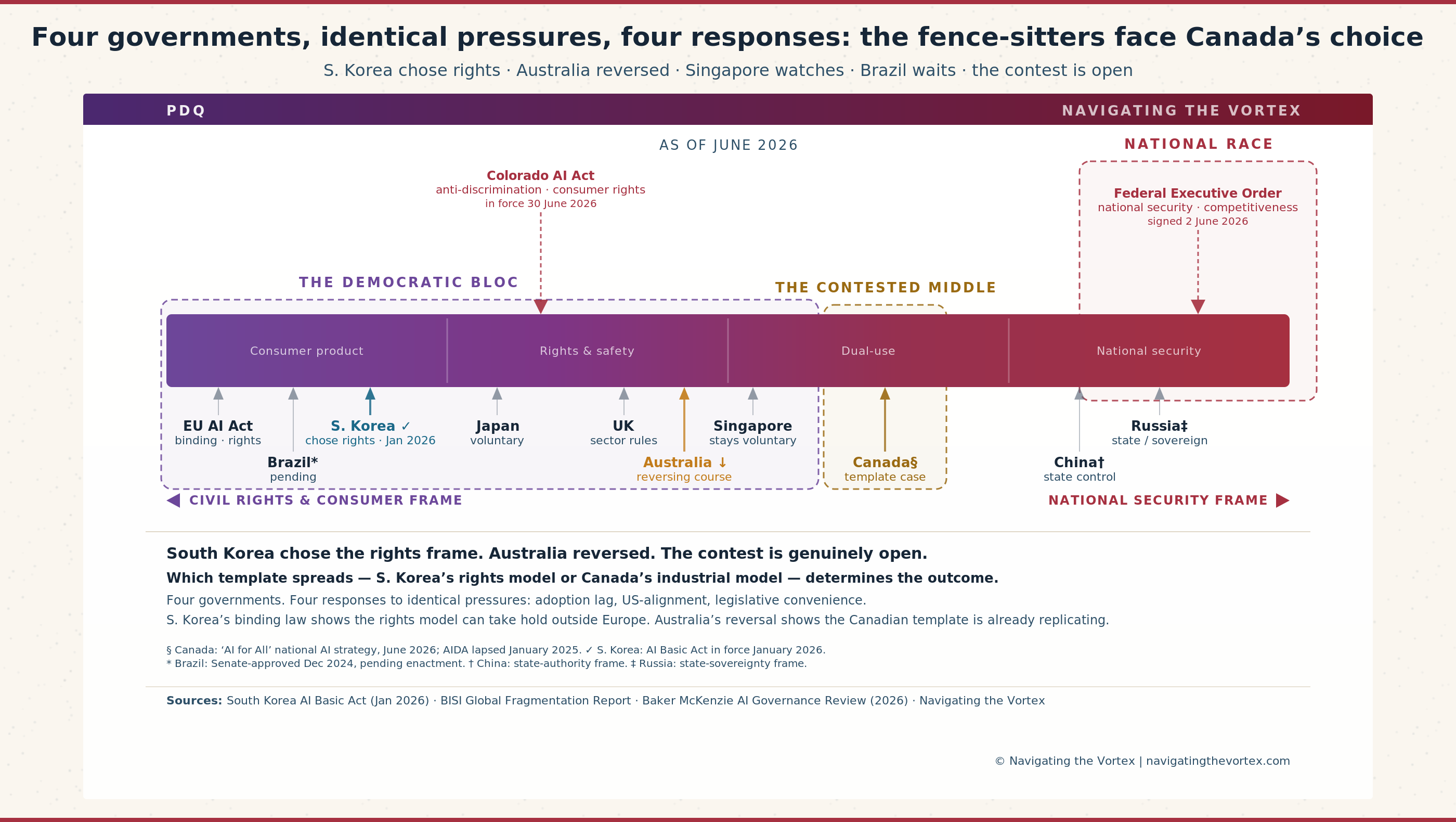
The governments most exposed to the same three forces are not a uniform bloc, and their varying responses matter for understanding which way the contest goes next. South Korea chose the opposite direction. Its AI Basic Act — the Asia-Pacific’s first comprehensive AI law — was promulgated in January 2025 and took effect on 22 January 2026. It establishes national governance structures, trustworthiness requirements, and binding obligations for high-impact AI systems in healthcare, energy, and public services. South Korea has large, globally competitive domestic AI-capable firms that might have argued for the industrial model. It chose rights-focused governance anyway. That shows the EU rights model is genuinely competitive in Asia, not only in Europe — it is not losing by default.
Australia is heading Canada’s way. In September 2024, the Australian government proposed ten mandatory guardrails for high-risk AI uses — a clear trajectory toward binding legislation. By December 2025, it had abandoned them, confirming that existing laws and sector regulators would carry the load, supported by voluntary guidance and an AI Safety Institute with advisory functions and no enforcement powers. In early 2026, Australia signed an AI safety cooperation agreement with Canada. Even if the pivot was quieter, the direction of travel is the same.
Singapore has taken a third path: voluntary, pragmatic, and deliberately non-binding. Its Model AI Governance Framework has been progressively extended; in January 2026 it published the world’s first governance framework specifically for agentic AI. There is no binding legislation. The posture is “show don’t mandate” — a framework that establishes Singapore as a reference jurisdiction without the compliance costs that would follow a binding AI Act, keeping its options open as the contest develops.
Brazil holds a rights-leaning position — it appeared as part of the rights coalition in Part 2 of this series — but its exposure to US trade pressure and a domestic growth gap that mirrors Canada’s create the same structural pressures. Its AI legislation is in progress, not yet entrenched. The three forces that drove Canada’s pivot are present. The timing is the only difference.
What the variation across these four governments shows is that the contest is genuinely open. The EU rights model can take root outside Europe — South Korea’s binding legislation proves it. But the Canadian template is already replicating in Australia. The question is which template spreads faster.
5. ‘Trust’ inside an industrial strategy is not a rights framework.
Canada’s AI for All positions trust as the strategy’s “north star.” Its first pillar — Protecting Canadians and Safeguarding Democracy — commits the government to legislation on deepfakes, AI-generated content labelling, and children’s safety online. A $50 million commitment funds the Canadian AI Safety Institute. The language of protection, responsibility, and accountability runs through the document.
None of it is equivalent to AIDA. AIDA would have imposed binding obligations on developers and deployers of high-impact AI systems: mandatory impact assessments, risk-management frameworks, documented human oversight requirements, and serious adverse incident reporting. Contravention carried penalties of up to 3% of global revenue. AI for All contains none of those mechanisms.
The distinction matters. Trust that enables adoption means trust that AI systems are reliable, accurate, and available — a design principle, enforced through reputational pressure and market incentives. Trust that constrains harm means a legal right to challenge a consequential AI decision — a compliance obligation with enforcement teeth. Only one gives a citizen a legal claim. Only one gives an organisation a defined liability exposure that its board must govern.
Industrial strategies consistently adopt the vocabulary of rights frameworks, because doing so reduces the political cost of departing from them. The word ‘trust’ in AI for All is not incidental. It is precisely the term that makes an industrial strategy sound like a continuation of a rights agenda when it is not. Every democracy that pivots will call its first pillar something like ‘trust’ or ‘responsible AI’ or ‘safe and beneficial deployment.’ Reading those phrases as equivalent to a rights framework is the category error the frame war is engineered to produce.
Read Canada not as a country changing its mind, but as the conditions under which any democracy could or would.
The three forces — economic lag, US-alignment pressure, and the political cost of defending rights legislation through a trade negotiation — are structural. They apply wherever growth lags, US trade exposure is real, and AI rights legislation has not yet hardened into institutional structures that survive executive reorientation. Canada did not invent a new political logic. It followed an old one.
The question for boards operating outside the EU is not whether your jurisdiction will face this choice. It will. The question is whether your organisation’s governance framework is built to the standard that survives the pivot — or only to the standard your jurisdiction currently requires. Those two standards are not the same when the political weather changes. In Canada, the weather just changed.
The three forces that drove Canada’s choice — economic lag, US-alignment pressure, and the political cost of defending rights legislation through elections — are present in some degree in every OECD jurisdiction. Which of these is most visible in your sector or region right now, and does that change how your board thinks about AI governance?
This series is free. Subscribe at navigatingthevortex.com — and get the story before the consensus forms.