



The AI Frame War — Part 2 of 4
This is Part 2 of The AI Frame War, a four-part PDQ series. Yesterday’s Part 1 mapped where major governments stand after June 2026’s three pivotal moves. This piece examines the two models competing for the rest of the world’s allegiance. Part 3 (Thursday) uses Canada as a case study in the choice every democracy faces. Part 4 (Friday) covers the American exception — Colorado’s AI Act vs. the federal Executive Order. Each piece stands on its own; together they map the AI frame war.
Two incompatible models are competing to become the world's AI standard. The contest is not between the US and the EU — it is between two models of how AI should be governed. Most governments have not yet chosen between them. The two models competing for their allegiance are already determining what every organisation can build, sell, and deploy — and in which markets.
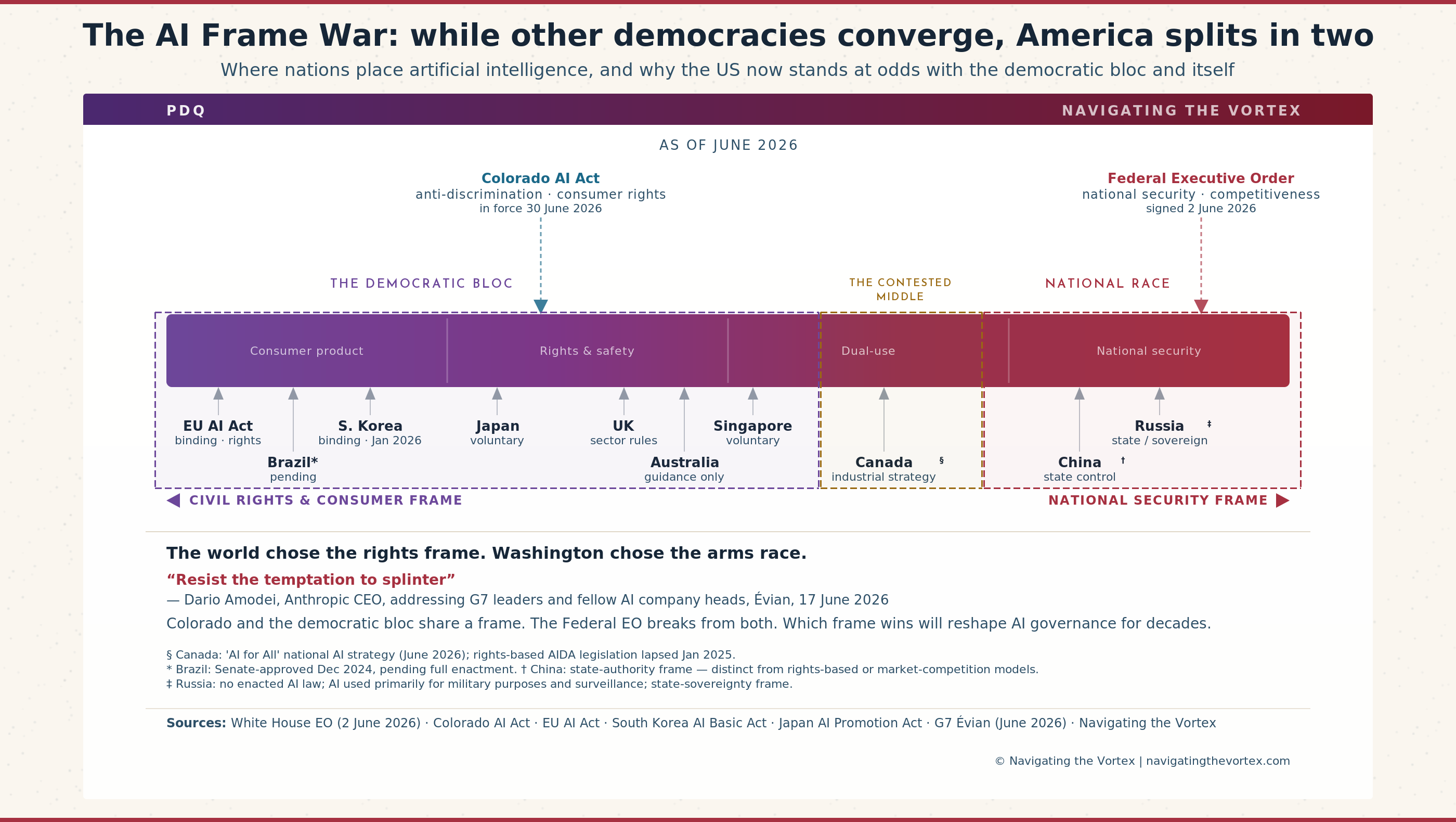
The EU AI Act is in force and exporting its rules through market access — the Brussels Effect that Anu Bradford named. On 2 June the US federal government, under the Trump administration, signed an Executive Order recasting foreign AI regulation as a threat to American competitiveness. Between those two poles sit the rest of the world’s governments — from Seoul to Brasília to Singapore — most of which have not yet chosen.
Yesterday’s Part 1 mapped where major governments now stand after June 2026’s three pivotal moves. This piece examines what is driving the map: two models — one built around rights, one around industrial power — in active contest for the world’s uncommitted majority, and what that contest means for every organisation that must place a bet on which one prevails.
1. Regulatory models spread through trade, not through persuasion. The Brussels Effect is real: the EU exports its rules by making market access conditional on compliance. It worked with GDPR because data standards are cheap to adopt — a privacy policy, a consent mechanism, a data-processing agreement. The AI Act is categorically harder. Compliance means product redesign, board-level accountability structures, mandatory impact assessments, and documented human oversight for high-risk systems — changes that take years and cost real money. Enforcement has barely begun. Diffusion of the rights model to the rest of the world is not assured by inertia; it requires active adoption pressure. That is precisely why the US Executive Order matters: Washington has recognised that the contest is about the global standard, not only the domestic one, and has entered it explicitly.
2. The race for the uncommitted majority is active and not yet won. The rights-model coalition — the EU, UK, Japan, South Korea, Australia, Brazil, and now Colorado — is real. So is the pressure pulling against it. India, the Gulf states, and much of Southeast Asia are watching Canada’s calculation and running the same numbers: rights compliance is expensive; industrial deployment is fast; US-alignment carries its own strategic value. The G7 met at Évian and produced no common framework. The prize is the majority of the world’s governments that have not yet committed to either model. Neither side has won it.
3. The multilateral gap is the contest’s decisive vulnerability. There is no WTO for AI — no binding international regime, no enforcement mechanism, no dispute-resolution process. Évian produced communiqué language, not a framework. The advantage goes to whichever model is first written into a trade condition — and the EU’s single market gives it the most powerful first-mover tool. For boards with cross-border trade exposure — procurement contracts, vendor agreements, digital services — the signal to watch is not another summit communiqué: it is the first bilateral or multilateral trade agreement that makes AI-framework alignment a market-access condition. That is when the contest moves from a regulatory preference into a compliance obligation your board will have to act on.
4. For an organisation anywhere, this is a fiduciary bet, not a regulatory one. If the rights model prevails, high-risk-AI accountability becomes a board duty with defined liability; if the industrial model prevails, obligations are lighter and faster but thinner on redress. Every product roadmap is already being built inside one assumption — and the wrong one means costly retrofits, regulatory exposure, and competitive disadvantage arriving at the same time. For boards outside the US sourcing AI systems from US vendors: those products were built to the federal industrial standard — no mandatory impact assessments, no consumer disclosure requirements, no right to appeal. Deploying them in EU, UK, Australian or Brazilian regulatory environments may leave a compliance gap between what the vendor built to and what your jurisdiction requires. Procurement due diligence now includes asking which framework your AI vendors were built to.
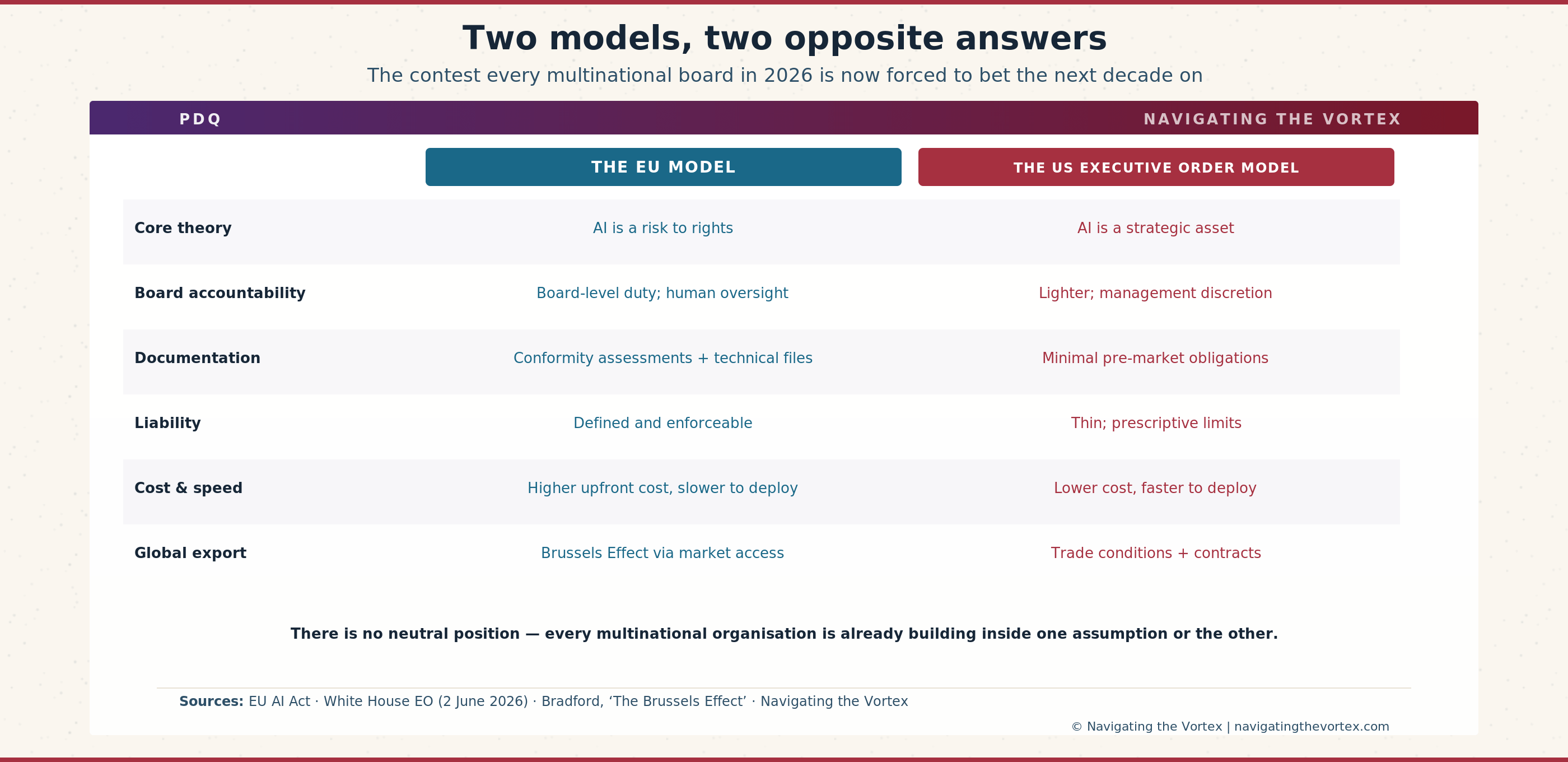
5. Every organisation now occupies a geopolitical position. Even “the US” is not one bloc: its federal government races on the industrial model while states like Colorado hold the rights line (Part 4). The pragmatic corporate default — comply with the strictest standard in any market you serve — quietly favours the rights model and puts organisations that adopt it ahead of those that build only to the federal standard. That default holds as long as the contest remains open.
The question for any organisation, in any market, is no longer which standard is cheaper to meet — it is which one you can afford to be caught on the wrong side of.
For multinational organisations already operating in rights-frame jurisdictions — the EU, UK, Australia, Japan, Brazil, or now Colorado — that question has an answer worth using: your governance approach is more internationally aligned than your US-federal-framework competitors. If you have built to the EU AI Act, you are ahead. That alignment is a procurement and stakeholder argument you can make explicitly — in a board paper, in a tender, in a client conversation. There is no neutral position from which to wait the contest out.
This series is free. Subscribe at navigatingthevortex.com — and get the story before the consensus forms.