



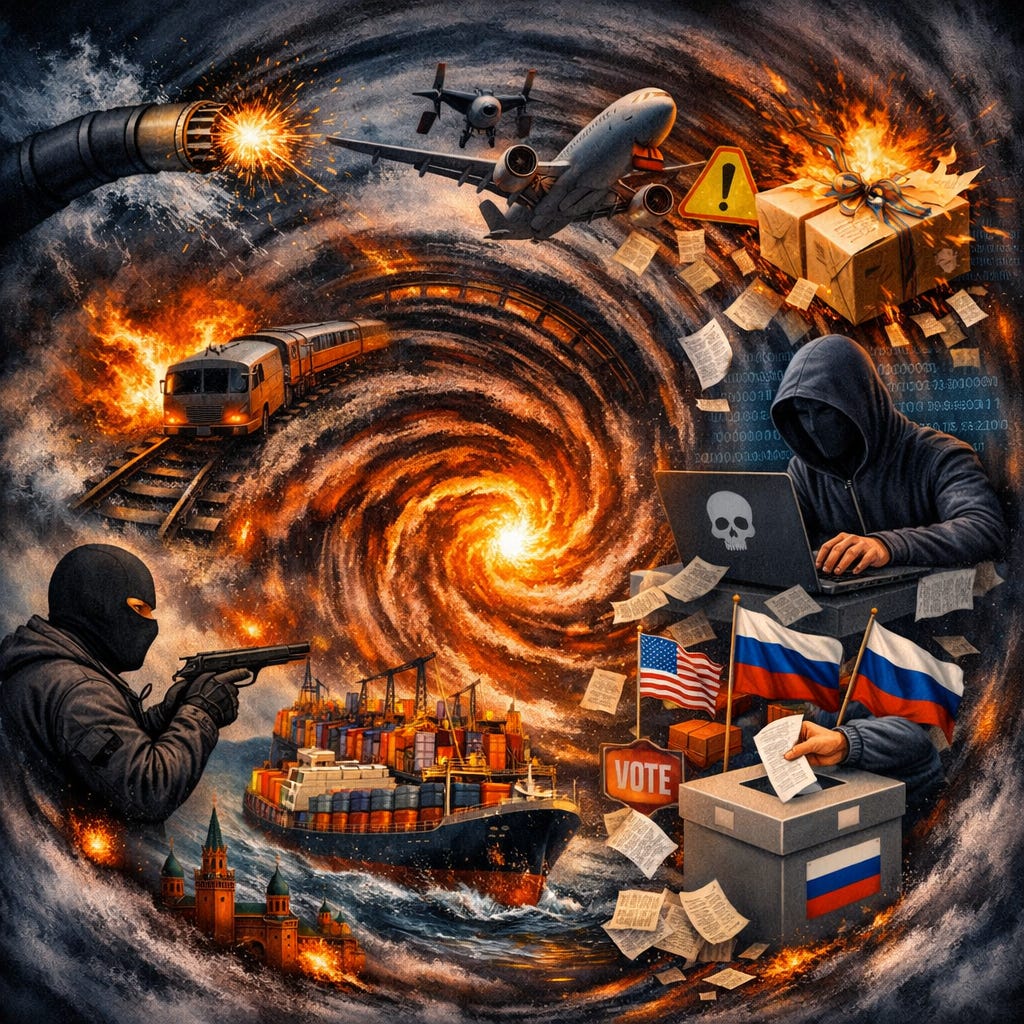
Russia’s campaign of hybrid warfare against Europe has Soviet roots and will likely outlast Putin. This analysis maps the campaign in precise, systematic terms: what it is, where it is targeted, why Russia is doing it, and — most importantly — how effective it has actually been. The assessment is unsettling not because the campaign is succeeding, but because the European response, while significantly improved, remains strategically deficient where it matters most: credible deterrence not just by denial but also by punishment.
The title of last year’s annual report of the Valdai Discussion Club offered an inadvertent self-portrait of Russian strategic intent: “Dr. Chaos or: How to Stop Worrying and Love the Disorder.” This is, of course, a telling play on Stanley Kubrick’s Dr. Strangelove — and a worrying one. Russia is not merely observing European disorder. It is manufacturing it.
What Russia Is Doing
Russia is conducting a sustained campaign of hybrid warfare: what the UK Ministry of Defence described in 2019 as “the synchronized use of multiple instruments of power tailored to specific vulnerabilities across the full spectrum of societal functions to achieve synergistic effects.” The European Commission offered a complementary definition in its 2016 Joint Framework on countering hybrid threats: “a mixture of coercive and subversive activity, conventional and unconventional methods — diplomatic, military, economic, technological — which can be used in a coordinated manner by state or non-state actors to achieve specific objectives while remaining below the threshold of formally declared warfare.”
Russia recognises the same concept under different labels — the “Gerasimov doctrine”, non-linear war or new-generation warfare, and the Soviet-era tradition of “active measures”. In practice, it involves a range of tactics: information warfare and disinformation; cyber operations; covert physical sabotage of critical infrastructure; the weaponisation of energy; the weaponisation of migration; and espionage and intelligence-led operations, including assassinations and assassination attempts.
Russia is not merely observing European disorder. It is manufacturing it.
These tactics are no longer just abstract labels. They have real-life manifestations: undersea cable disruptions in the Baltic Sea; incendiary parcel bombs in DHL distribution centres in Birmingham, Leipzig, and Warsaw; sabotage of Poland’s railway network; drone flights disrupting civilian aviation in Denmark, Germany, and Norway; hack-and-leak attacks against the German SPD in 2024 and against a range of UK officials in a campaign starting in 2015; election interference in Romania and Moldova; and actual and attempted assassinations of former Russian spies in the UK, including Alexander Litvinenko in 2006 and Sergei and Yulia Skripal in 2018.
What follows maps what and where Russia’s targets are and examines how Europe's response — while strategically deficient right now — can rise to the permanent challenge that Russia poses.
