




When a firm meets a scandal by appointing an independent chair, the most revealing thing is what it has decided not to change.
KPMG Australia has just lost its chair and two senior audit partners, after its chief executive and audit chief before them. The trigger was the misuse of clients’ confidential board papers — Lendlease’s, Optus’s, and Dexus’s — to help the firm win audit work from their rivals. ASIC is now investigating — though its own jurisdiction reaches individual registered auditors, not the partnerships that employ them, a structural gap this piece returns to below. The response, announced alongside the resignations, is a governance overhaul: an independent chair, independent board members, fresh oversight of audit quality and ethics, a new look at how whistleblower complaints are handled. It is the textbook answer. It is also an answer to the wrong question.
The chair the firm settled on makes the point better than I could. KPMG named Michael Ebeid AM as its first Independent Chairman on 2 July — framed as the centrepiece of the overhaul, and an appointment that immediately drew fire in Parliament for being nothing of the kind. Senator Barbara Pocock called it “KPMG’s version of a ‘cleanup’”: Ebeid was already sitting on the board, not an outside appointment, and correspondence released the same day raised further questions about his regard for the whistleblower process the overhaul was meant to fix. A new chief executive, John Sams, followed on 21 July. Both appointments are real governance moves. Neither touches the partner-compensation structure this piece is about.
This is not, at root, a confidentiality breach. A breach is something that happens to a system from the outside. What happened at KPMG happened because of the system. The Big Four are partnerships, and in a partnership the people who profit from winning the next engagement are the same people entrusted with the client’s most sensitive information. The partner who reads Lendlease’s board papers is a partner whose income depends on winning the next big audit. We have built a structure that asks one person to be both the custodian of a client’s secrets and a beneficiary of using them — and then we are surprised, every few years, when the two roles collide.
We ask one person to be both the custodian of a client’s secrets and a beneficiary of using them — then act surprised when the two roles collide.
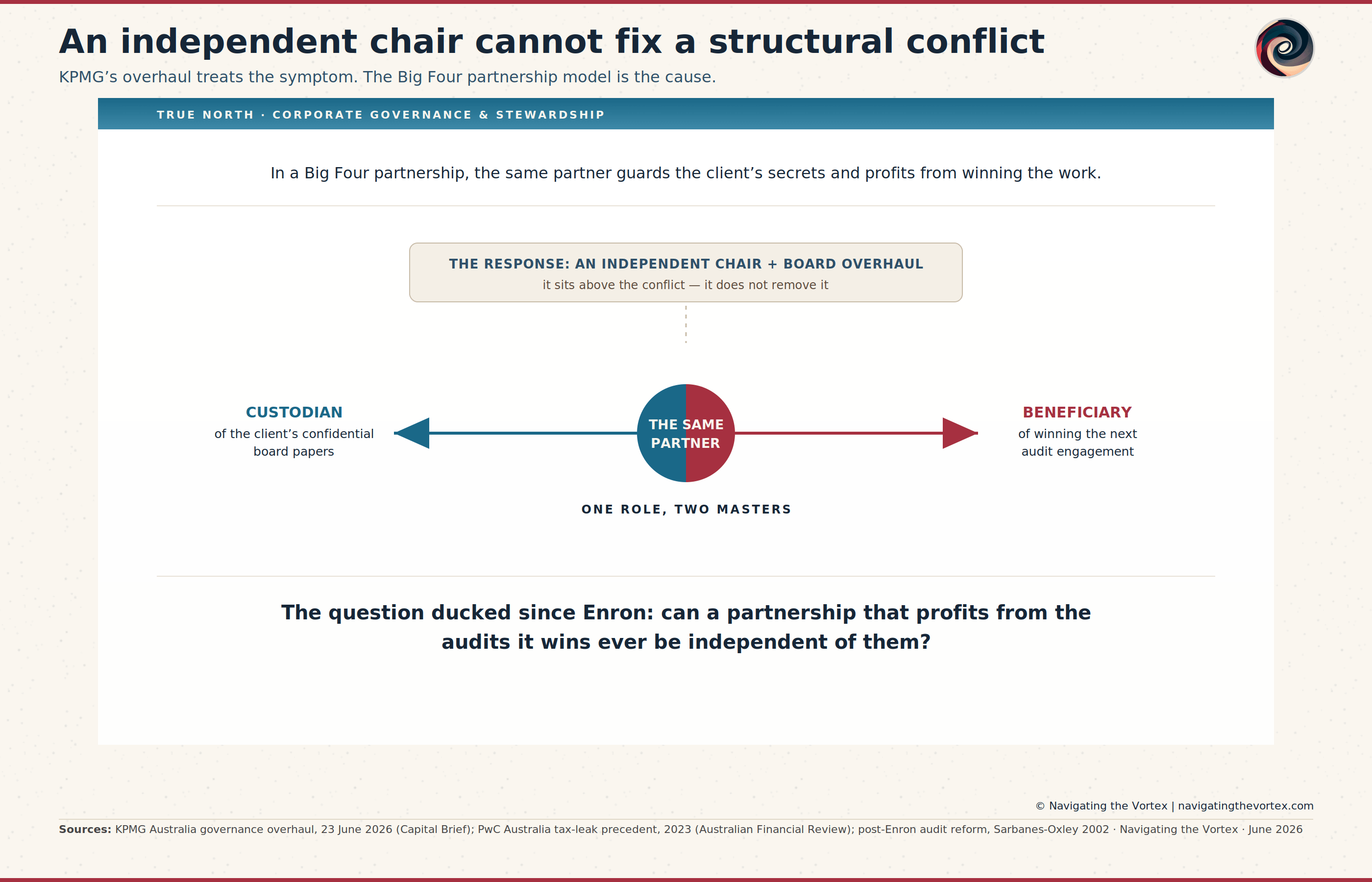
That is why the scandals rhyme. PwC Australia’s tax-leak affair in 2023 ran on a different mechanism — confidential government tax plans, monetised by the very firm hired to help write them — but it had the same architecture: privileged information on one side of the partner’s desk, a commercial incentive on the other, and nothing structural between them but the partner’s own restraint. The firms answer each episode in the same vocabulary — independence, oversight, culture, an external review — and each time the vocabulary is applied to the symptom and not the structure.
We have been here before, at scale. After Enron and the collapse of Arthur Andersen, the reforms of 2002 — Sarbanes-Oxley, mandatory audit-committee independence, partner rotation, limits on selling consulting to audit clients — were built to wall the auditor off from the incentives that corrupt the audit. Australia ran its own version the year after, following the HIH collapse — CLERP 9, partner rotation under the Corporations Act, an ASX rule mandating audit committees for its largest listed companies. Different statute books, same three levers. They did real work. But they left the deepest incentive untouched: the partnership itself, in which the audit is a product the firm sells and the partners share in the proceeds of selling it. The reforms regulated the conflict. They did not remove it — because removing it would mean asking whether a partnership that profits from the audits it wins can ever be independent of them, and that is a question the profession and its regulators have been content to leave unasked.
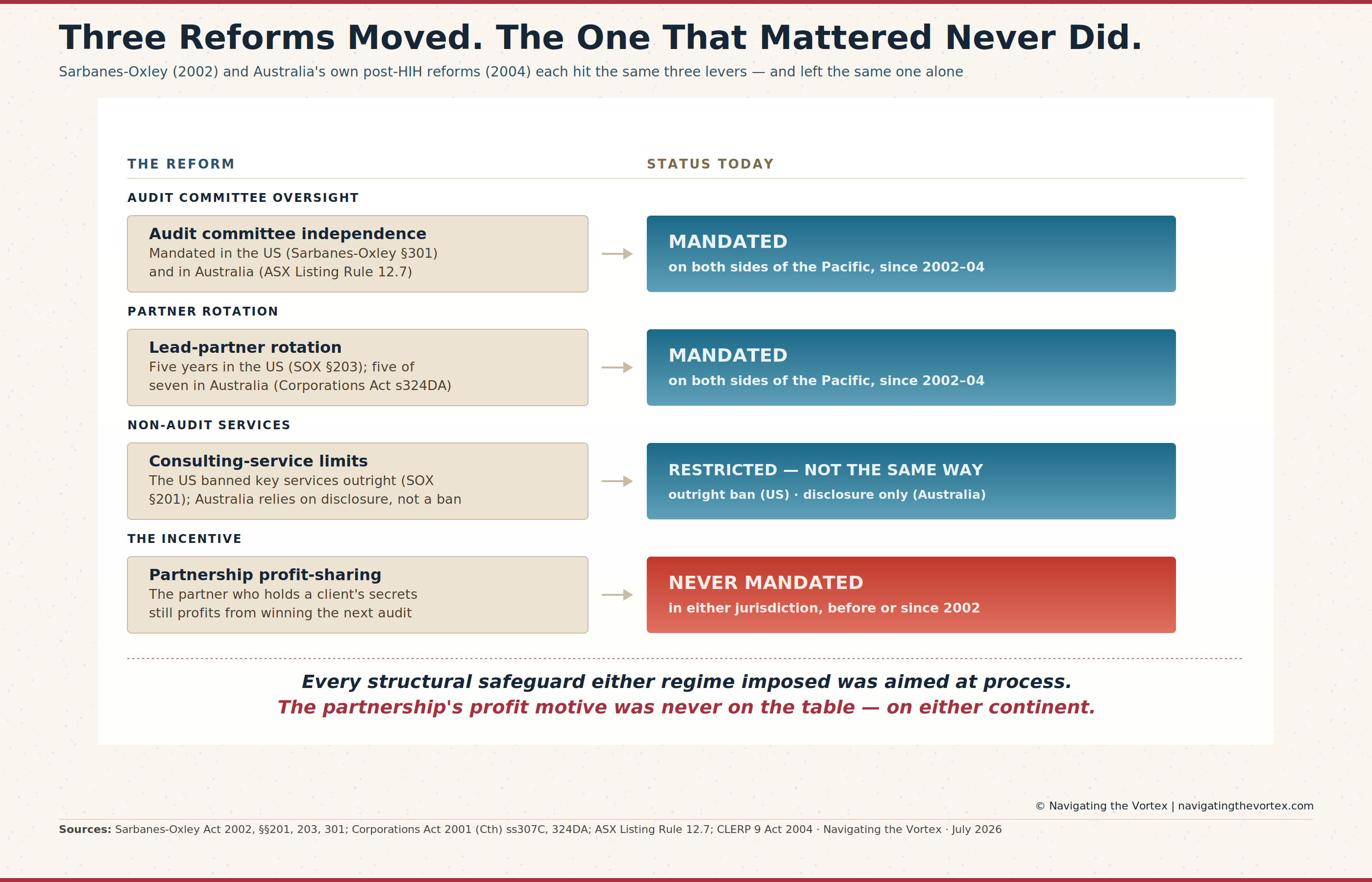
Those reforms were built for a narrower firm than the one being asked to hold them now. KPMG in 2002 was close to a pure audit and accounting practice; the Big Four today are sprawling multi-line consultancies — audit, tax, advisory, technology, deals — selling all of it into the same client relationships they are supposed to audit without fear or favour. An independent chair is a good and necessary fix for a governance failure. It is not a fix for a firm that has simply grown too complex, with too many live conflicts, for the partnership structure it still runs on. The question is not only whether the 2002-era guardrails still hold. It is whether the partnership model itself is still fit for purpose for a firm this size and this shape.
I have sat on the committees that receive these assurances, and the tell is always the same: the remedy is aimed at perception. An independent chair changes who sits at the head of the table; it does not change what the people around it are paid to do. New whistleblower guidelines change the process for reporting misconduct; they do not change the incentive that produces it. None of this is worthless — process matters, and a firm that handles a complaint honestly is better than one that buries it, as KPMG’s own inquiries did until Parliament forced the issue. But a board that accepts the overhaul as the answer has confused tidying the room with fixing the house.
The harder options are the structural ones the overhaul avoids. Separate audit from advisory entirely, as reformers have urged for two decades. Cap or rotate the commercial relationships that give the conflict its force. Or concede openly that “independence” inside a profit-sharing partnership is a regulated fiction we have chosen to live with, and supervise it as such. Each is uncomfortable. Each is a real answer. An independent chair is none of them.
KPMG’s people did a serious thing, and the resignations are warranted. But we should be precise about what their departure settles and what it does not. It removes the individuals. It does not touch the incentive that will, in time, produce their successors’ version of the same scandal. The lesson of the Big Four is not that they keep hiring the wrong people. It is that the structure keeps asking the right people to serve two masters — and then dresses the predictable result in the language of reform. Until a regulator is willing to ask whether the partnership model is compatible with the independence the audit function requires, the independent chair will keep being the answer. It will just keep being the answer to the wrong question.
If a regulator forced audit firms to choose — separate audit from advisory entirely, or accept full liability for the conflicts the partnership model creates — which would the profession actually pick?