



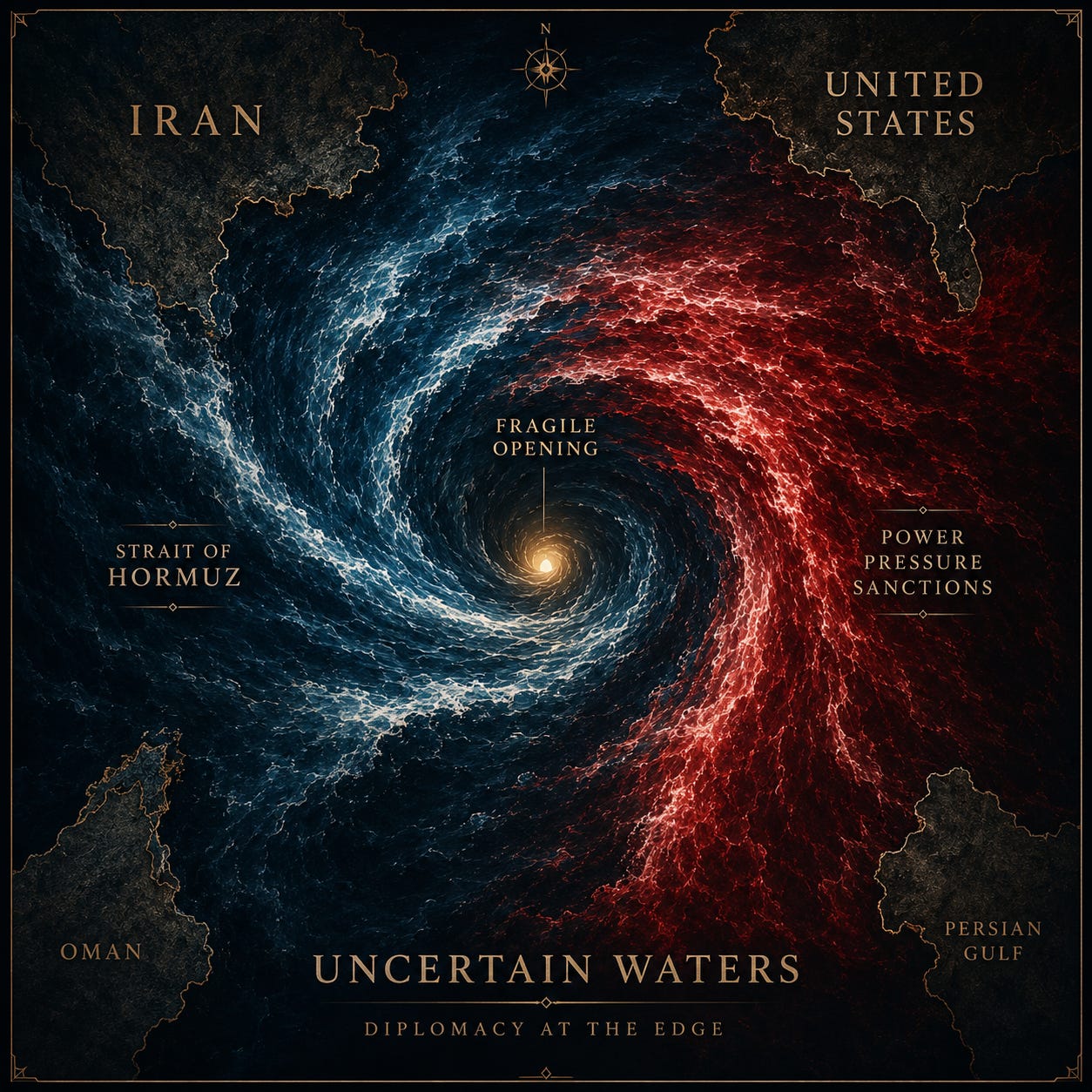
After first announcing late on May 23 that a deal with Iran had been “largely negotiated”, US president Donald Trump then backtracked less than 24 hours later, stating that he had instructed his negotiators “not to rush into a deal”. So far, so usual for Trump’s approach to diplomacy.
Over the past week, the pathway to a deal between the US and Iran had become both more credible and more narrow at the same time. Brinkmanship has escalated on both sides, with Trump threatening renewed escalation, then pulling back — after an intervention by Gulf allies — but leaving it on the table as a credible option. This was matched by Iran threatening a wider regional response to any renewed US strikes. Over the past year, both sides have demonstrated enough capacity and willingness to underscore that these are not empty threats.
This basic logic has not changed over the weekend. The risk of escalation, therefore, is real, which, in turn, narrows the time available for a deal but also makes it more likely because both sides stand to lose from a return to all-out war. For the regime in Tehran, the potential consequences are existential; for the White House, they may be more reputational — any decisive military victory will entail enormous humanitarian suffering in the region and cause long-term economic pain globally and domestically — but these are still significant costs for an administration heading into crucial mid-term elections.
The risk of escalation, therefore, is real, which, in turn, narrows the time available for a deal but also makes it more likely because both sides stand to lose from a return to all-out war.
The credibility of escalation and its likely cost have created a window of opportunity for a renewed push for a deal, reflected in intensifying Pakistani mediation efforts. The arrival of high-profile officials from Islamabad in Tehran — the army chief and the interior minister — carrying the latest US proposal signals a potentially viable route to a deal.
Even more so, the re-entry of Qatar into the mediation process is an indication that the Arab Gulf states sense that a deal might be possible, which they want to be able to shape as much as possible. Qatar has traditionally had a role as a mediator and retains multiple backchannels to key actors in the conflict, including Iran and the US. This makes its re-entry acceptable to both Tehran and Washington. That Doha is willing to take the diplomatic risk that this move involves is also a sign of both the urgency that countries in the region feel to prevent a renewed escalation of the war and the narrow window of opportunity that they currently see to achieve it.
Further away from the region, on May 22, the Council of the European Union decided to extend its sanctions framework against Iran, specifically targeting individuals and entities deemed to undermine freedom of navigation in the Middle East. No-one was specifically named, which adds pressure on Iranian negotiators but also creates incentives to reach a deal — on re-opening the Strait of Hormuz. This is significant because it positions the EU for a potential role in a post-deal operation in implementing new arrangements to uphold freedom of navigation in the Strait, similar to the role it already plays in the Red Sea with its Operation Aspides. The expanded sanctions framework, which comes on top of the wide range of existing sanctions, further adds to the independent diplomatic leverage of the EU: it can impose and renew sanctions on Iran but crucially also remove them in exchange for a deal, and can do so independently of the US.
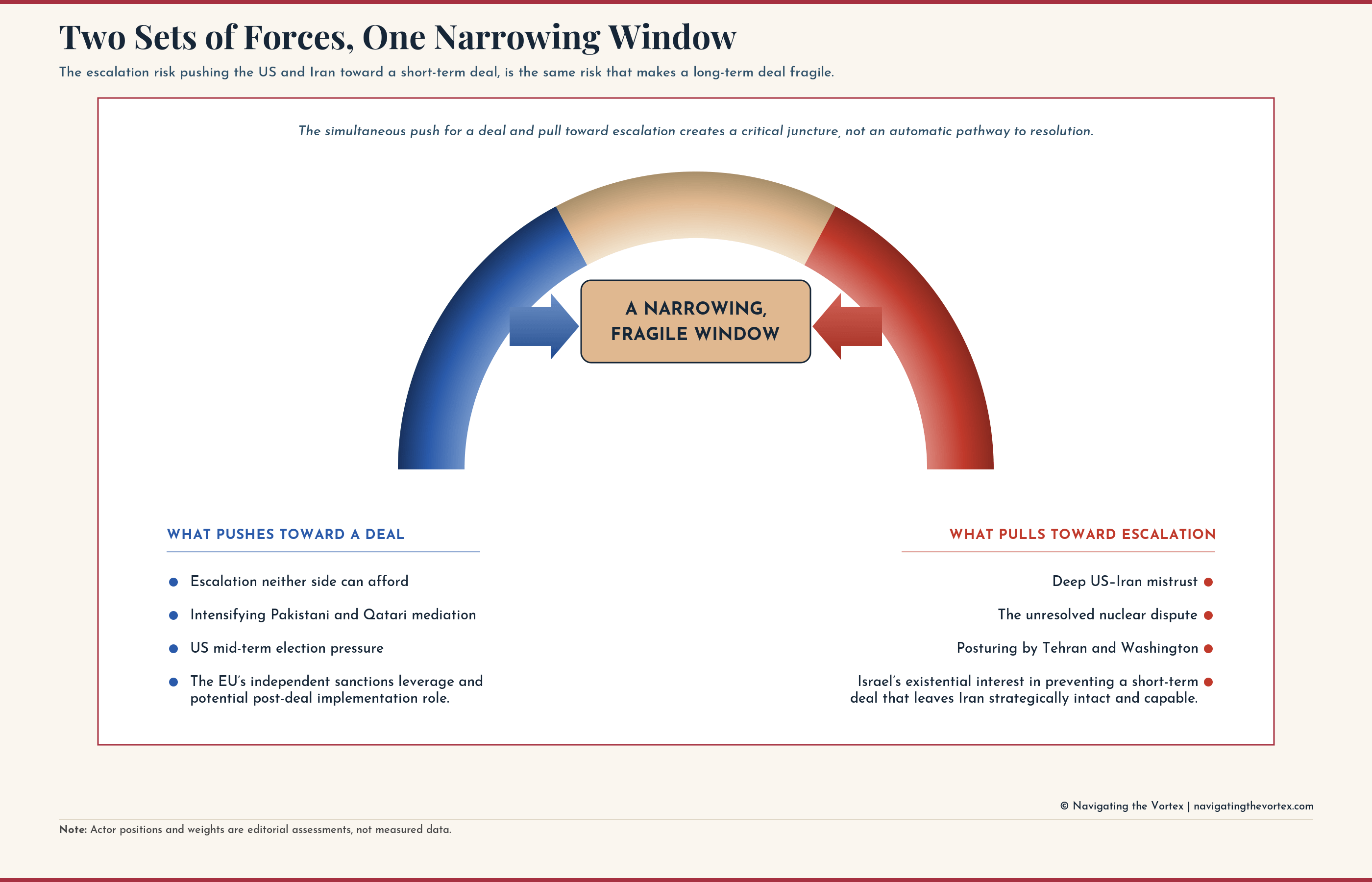
All of these developments, however, also expose two long-term structural vulnerabilities. Current efforts are primarily focused on short-term gains: preventing an all-out resumption of the war between the US and Iran and across the region and reopening the Strait of Hormuz. This may be possible but is likely to include some commitment to a process to resolve the more fundamental underlying dispute over Iran’s stockpile of highly enriched Uranium and its future enrichment capabilities, and possibly its ballistic missiles programme and support for regional proxies.
These are issues over which sustainable agreement has eluded negotiators for a long time and the sides’ stated positions will make any compromise extremely difficult and time-consuming to achieve. Whatever deal might be achieved now on the Strait of Hormuz, therefore, will not remove the risk of escalation later. The lack of trust between Tehran and Washington, public posturing by both Trump and Iran’s Revolutionary Guards, and the potential for even minor incidents in a yet-to-be-agreed new regime for the Strait of Hormuz will create a combustible mix of risk factors that will at best prolong a volatile ceasefire and at worst simply postpone the resumption of hostilities until one side perceives a road to victory.
Whatever deal might be achieved now on the Strait of Hormuz, therefore, will not remove the risk of escalation later.
There is an important wild card in all of this: Israel. The strategic preferences of Tel Aviv are fundamentally mis-aligned with those of the US, Arab Gulf states, and Europe. Israel requires a comprehensive neutering of Iranian nuclear, ballistic missile, and regional proxy capabilities. The US under Trump seems to have settled for a transactional framework deal that trades re-opening of the Strait of Hormuz for a longer-term commitment to negotiating a new regime curbing Iran’s ability to acquire nuclear weapons (not unlike the JCPOA original nuclear deal of 2015 which Trump abandoned in 2018). The Arab Gulf states and Europe are similarly keen on rapid de-escalation and more strongly committed to long-term stabilisation, especially with an eye to secure energy flows from the region.
The mis-alignment of preferences, and the perception of an existential threat from Iran, creates the incentives for Israel to torpedo any short-term deal that seems currently possible. Israel’s ability to do so hinges on whether Netanyahu can drag Trump back into an all-out war, including by launching unilateral strikes on targets in Iran or whether he is willing to escalate his war against Lebanon in order to trigger Iran to walk away from negotiations now. Both of these options have significant disruptive potential and Israel has a track record of using them – despite the risks they involve. Importantly, they are also not simply options for the short term but threats that Israel can wield in the longer term, heightening the risk to subsequent talks under a US-Iran framework deal.
The mis-alignment of preferences, and the perception of an existential threat from Iran, creates the incentives for Israel to torpedo any short-term deal that seems currently possible.
In a phone call with Trump on May 24, Netanyahu apparently kept insisting that “Israel will maintain freedom of action against threats in all arenas, including Lebanon”.
Constraining Tel Aviv, therefore, is both a short-term priority and a long-term necessity. In the short-term, pressure on Netanyahu might be effective. In the long-term, only a deal with Iran that assuages existential Israeli security concerns will do.
This analysis draws on Stefan Wolff’s article published in CNA on 25 May 2026.
Stefan argues that a deal reopening the Strait of Hormuz would postpone the confrontation rather than resolve it — and that constraining Israel is the precondition for a settlement that lasts. For a government or a business with material exposure to the region, is a near-term deal a genuine de-risking event, or a window that merely resets the clock?
We hope you’ll share Navigating the Vortex with anyone you think might find it of interest. Also, you can listen to our podcast editions via the website and on all major podcast platforms, including Apple Podcasts, Spotify, and Amazon/Audible.