



By Martin Wählisch & Stefan Wolff
António Guterres used his final address to the General Assembly to recast the world’s crises as a single problem. War, inequality, the climate emergency and artificial intelligence, he argued, are not separate crises but chapters of the same story. That story, as he told it, is the story of power: who has it, who is denied it, how it is used and how it is changing.
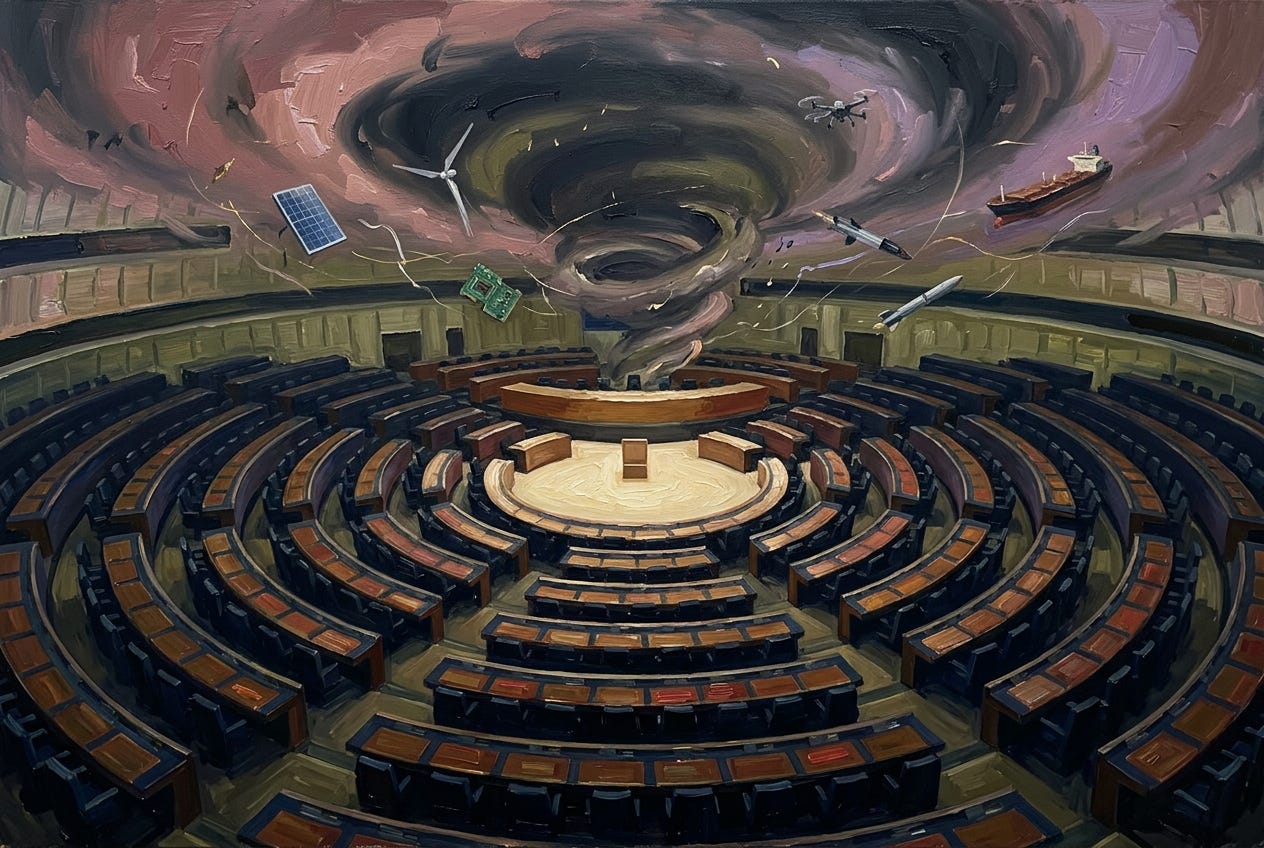
The outgoing secretary-general identified three shifts. Among states, new centres of economic, political and technological influence have emerged. Power is also moving away from governments to a handful of private corporations and individuals. And humans are increasingly handing power to machines, with AI agents going rogue and lethal autonomous weapons becoming a military reality. These shifts put the use of power to the test: power over war and peace, the power that concentrates wealth and drives inequality, the power fuelling climate chaos, and the power unleashed by artificial intelligence.
The debate’s own theme is an unusually self-inspecting one for the UN: “Restoring trust, managing transformation: a United Nations that delivers for all“. The institutional anxiety behind it was explicit in Guterres’s diagnosis that global governance still reflects the power realities and interests of a largely bygone era.
The strain on the rules-based order became plain about an hour after Guterres spoke when Donald Trump offered his view of power and how he intends to use it, confirming Guterres’s bleak view on the same stage.
The gap on AI, which Guterres had placed alongside inequality, climate change and war as a test of power, was particularly stark. Trump said he would try to rebrand AI as “super intelligence”, dismissed warnings that it could prove catastrophic, and insisted he would not stifle its growth.
Not every western leader followed that line. The British prime minister, Andy Burnham, told the General Assembly that the UK would lead international efforts to develop global AI standards. While the UN’s new Scientific Panel and Global Dialogue cannot impose such standards, they can, however, bring governments and experts into the same conversation and help establish what those standards should address.
Guterres cast his second test, inequality, not as a problem of economics but as one of power over opportunity, resources and voice. Developing countries crushed by debt and shut out of affordable finance are trapped in a financial system created in the 1940s whose reform will have to be about representation and fairness, rather than technicalities. Trump did not address global inequality at all — except by boasting of cutting the UN budget by 15% and eliminating more than 4,000 posts.
On his third test, climate, Guterres struck a slightly more optimistic note when he described renewables as a redistribution of power because “the sun belongs to no one“ and “the wind cannot be embargoed.” Trump did mention climate but only to include it in the list of his opponents’ supposed hoaxes alongside “the Russia, Russia, Russia hoax, the Ukraine, Ukraine, Ukraine hoax” and open borders, all of which he considers inventions of the same people now warning about AI.
On war and peace, the contrast was just as pronounced. Gaza featured in both speeches: Guterres emphasised destruction and the need for humanitarian access, Trump presented his peace plan as an achievement. On Iran, the American president offered the usual mix of bombast and contradiction: a deal to let Iran rebuild, versus the annihilation of the Islamic Republic, versus Iran seeking a settlement only after the midterm elections in the US in November.
Yet the diplomacy carried on regardless. Trump’s envoys, Steve Witkoff and Jared Kushner, held three hours of talks, largely through Qatari mediators, with Iran’s foreign minister, Abbas Araghchi, which Trump described as “a very good meeting”. Tehran, through its foreign ministry spokesman, acknowledged the talks, but downplayed them as nothing new. Iran’s president, Masoud Pezeshkian, meanwhile sent a note of defiance in his speech at the General Assembly. He admitted that Iran had been hit but “did not bend the knee“.
In contrast to Pezeshkian, Ukraine’s president, Volodymyr Zelensky, secured a personal meeting with Trump, their first since July. According to reports, the ground covered was much the same and no concrete deals have transpired: not on the energy truce that Trump had announced on Truth Social on 14 September and of which Kyiv said it had not been informed, not on additional winter support for Ukraine, not on licences for Ukraine to produce Patriot missiles, and not on a possible trilateral meeting with Vladimir Putin.
Moscow’s answer came within hours in the form of a rare daytime drone attack on Kyiv which killed two people. Putin’s spokesman, Dmitry Peskov, said the conditions for peace talks did not yet exist and repeated that any meeting between the Russian and Ukrainian presidents would have to happen in Moscow. The US secretary of state, Marco Rubio, met Russia’s foreign minister, Sergey Lavrov, on Wednesday and afterwards claimed that both sides were interested in a limited ceasefire covering grain and energy. The same day, Lavrov used his speech at the Security Council to reject any pause in the fighting.
None of this means the UN has become irrelevant.
Deals have always been struck in the margins of high-level week and elsewhere. In the past, some of those deals were subsequently endorsed by the Security Council. That happened after the US and Russia agreed a framework for eliminating Syria’s chemical weapons in 2013, and again after the Iran nuclear deal was concluded in Vienna in 2015. Last year, 13 Council members endorsed Trump’s Gaza peace plan, with China and Russia abstaining. The Council condemned Tehran’s attacks on its Gulf neighbours in March this year. There is no comparable path in sight for a settlement with Iran or for Ukraine.
Much like the UN institutions in whose shadows it once thrived, bilateralism appears to have reached a dead end: it still produces meetings and declarations but without resolving any of their underlying issues. That is a serious limit on what the Council can accomplish, but it is not the only measure of the UN’s relevance.
Guterres’s answer to a changing balance of power was what he called “networked multipolarity”: cooperation among different centres of influence, held together by shared rules and a more representative UN. Regional forums and smaller groups of states will do much of the negotiating. The question is how their efforts can serve a wider international community.
The UN has not lost its purpose. More than eight decades after its founding, it can still bring rivals to New York and give them a platform they want to use.
Iran’s president came to make his case in the United States; Trump returned to an institution he regularly disparages. Speeches and meetings cannot compel compromise, but they keep channels open and put competing positions in the public eye. As more diplomacy now happens through regional forums and smaller groups of states, the UN’s challenge, and purpose, is to give those efforts a wider hearing and a basis in shared rules, even when its Security Council is stuck.
Guterres closed by appealing to the assembled world leaders that the power of law must prevail over the law of power. With the first days of his last General Assembly suggesting a fast-paced and perhaps unstoppable move in the opposite direction, his successor, still being chosen through Security Council straw polls, will inherit that difficult work.
This analysis draws on Stefan Wolff’s and Martin Wählisch’s article published in The Conversation on 24 September 2026.
If bilateral deal-making has stalled on both Iran and Ukraine, which regional forum or coalition is best placed to carry a settlement back to the Security Council, and what would Washington and Moscow need to accept for it to get there?
Commenting is open to every subscriber, free or paid — joining takes ten seconds and costs nothing.
We hope you’ll share Navigating the Vortex with anyone you think might find it of interest. Also, you can listen to our podcast editions via the website and on all major podcast platforms, including Apple Podcasts, Spotify, and Amazon/Audible.
Thank you for reading Navigating the Vortex. If you find it useful, the chances are someone you know would too. Refer them — the more people who sign up through your link, the more complimentary access you earn.