



In the early hours of 16 August 2026, Ukraine launched roughly 600 drones at Moscow — one of the largest single strikes on the Russian capital since the beginning of war nearly four-and-a-half years ago. Moscow’s mayor said 201 of the drones were destroyed over the city and region; Russian officials reported at least six people killed across the Moscow and Rostov regions, while Russian strikes on Kryvyi Rih killed one person and wounded six.
Hours earlier, a Spanish F-18 flying a NATO air-policing mission over Romania shot down a Russian drone that had crossed into its airspace — the fourth such incident this year. The exchange lands amid an escalating air war in which Russia fired more than 450 missiles at Ukraine in a single month, nearly 200 of them ballistic, while Ukraine has struck Russian oil refineries 194 times in the first half of 2026.
1. Neither side can currently force a breakthrough on the ground. The Institute for the Study of War’s battlefield assessment of 11 August records no confirmed advances around Pokrovsk, Kupyansk or northern Kharkiv Oblast, even as both militaries keep attacking there. Strikes on refineries, air-defence networks, industrial sites and major cities, including now Moscow itself, are highlighting that both sides are doubling down on attritional escalation, hoping that putting pressure on infrastructure and civilians will eventually help them achieve the territorial breakthroughs – either on the front line or at the negotiating table – that have eluded them so far.
2. Ukraine’s deep-strike campaign is a genuine doctrinal shift, not a one-off spectacular: 194 hits on Russian refineries in the first six months of the year, and Saturday’s roughly 600-strong drone raid on Moscow, compensate for the manpower and artillery deficit Ukraine cannot close on the ground by moving the war’s cost into Russia’s own economy and psychology. But it operates alongside a static front, not as a substitute for one — nothing in the refinery attacks or Moscow strikes changes who holds Pokrovsk.
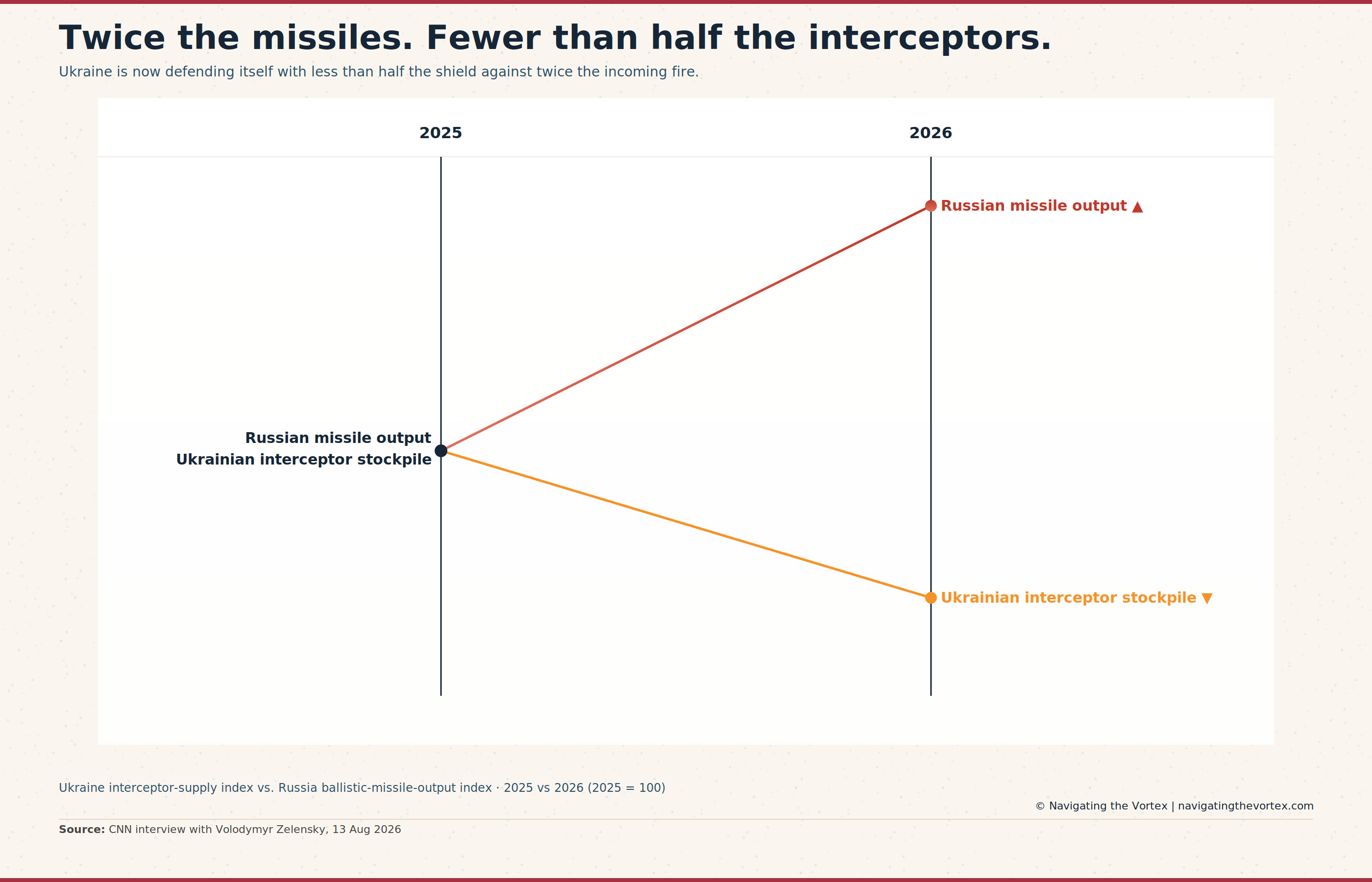
3. Lack of air defences is Ukraine’s most critical vulnerability now and going forward. Zelensky told CNN this month that Ukraine is receiving roughly 1% of the interceptors it needs and holds two-and-a-half times fewer than in 2025, while Russia has roughly doubled its monthly ballistic-missile output — the gap showed in a single early-August strike, when Ukrainian air defences failed to down a single one of 28 ballistic missiles fired at Kyiv. Russia’s resumed use of North Korean KN-23 missiles, which allows Moscow to keep up pressure on Kyiv while protecting and increasing the stockpile of its own cruise and ballistic missiles ahead of its annual winter campaign against Ukrainian critical civilian and especially energy infrastructure.
4. The timing of the current escalation on both sides is not accidental. Ukraine’s campaign of intensifying deep strikes happens as Steve Witkoff and Jared Kushner allegedly prepare to travel to both Kyiv and Moscow this month, and Zelensky has said explicitly that squeezing Russian oil revenue and military production is meant to move Putin toward an air ceasefire. Yet, there is little hope that Witkoff and Kushner will be able, or indeed willing, to change the Kremlin’s calculus. It took them and the White House nearly a year to accept that Kyiv’s refusal to cede the rest of Donbas is not a negotiating position but a red line. With Russia’s equally uncompromising stance, any negotiations appear deadlocked even before they have started.
5. Both sides, therefore, currently have more incentive to keep striking than to enter negotiations. They do not see themselves in a position of sufficient strength that would allow them to extract concessions at the negotiation table that they cannot achieve on the battlefield. This makes near-term de-escalation unlikely and dooms any efforts by Witkoff and Kushner. The turning point, if one comes, is more likely to arrive through attrition than through a single event. If Western air defence pledges materialise before Ukrainian cities face the next winter, Ukraine’s resilience might outlast Russia’s ability to cope with mounting refinery losses that constrain its war economy. If, on the other hand, Russia’s missile production (and North Korea’s support) outpaces Ukraine’s capacity to deploy effective interceptors in sufficient numbers, the prospects of a just and lasting peace will diminish rapidly.
Commenting is open to every subscriber, free or paid — subscribing takes ten seconds and costs nothing.
Thank you for reading Navigating the Vortex. You’re part of a readership shaping decisions across five continents, from multinational boardrooms and global finance to international law and foreign ministries. It includes Britain’s Foreign, Commonwealth and Development Office; the OSCE; NASA’s Jet Propulsion Laboratory; Yale University; and the University of Sulaimani.
If the publication gives you clarity or insight, the chances are someone you know would value it too. Share your link. The more people who subscribe through it, the more complimentary access you earn to content that is normally paid-for.
You can listen to our podcast editions via the website and on all major podcast platforms, including Apple Podcasts, Spotify, and Amazon/Audible.