




The United Arab Emirates announced on Tuesday 28 April 2026 that it is withdrawing from OPEC and the OPEC+ alliance next month, dealing what the Financial Times called “a significant blow to the oil cartel and its de facto leader Saudi Arabia.” UAE Energy Minister Suhail Mohamed al-Mazrouei told Reuters the decision followed “a careful look at current and future policies related to level of production.”
The move follows years of Emirati frustration with OPEC’s quota system. It also comes amid ongoing tensions between the UAE and Saudi Arabia. And it happens against the background of the closure of the Strait of Hormuz — where Iran’s military had effectively seized control of shipping lanes in early March after US and Israeli attacks against the country.
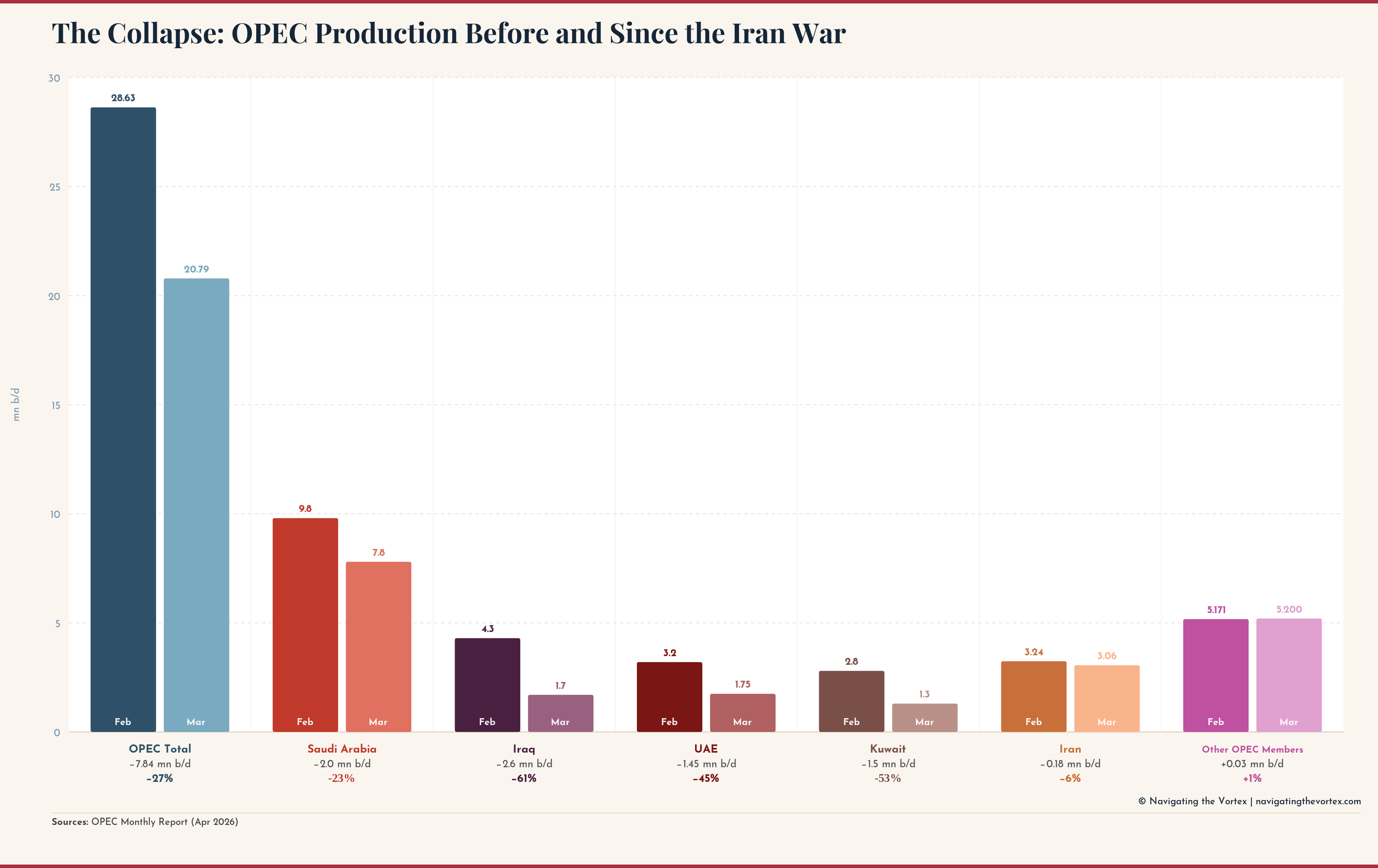
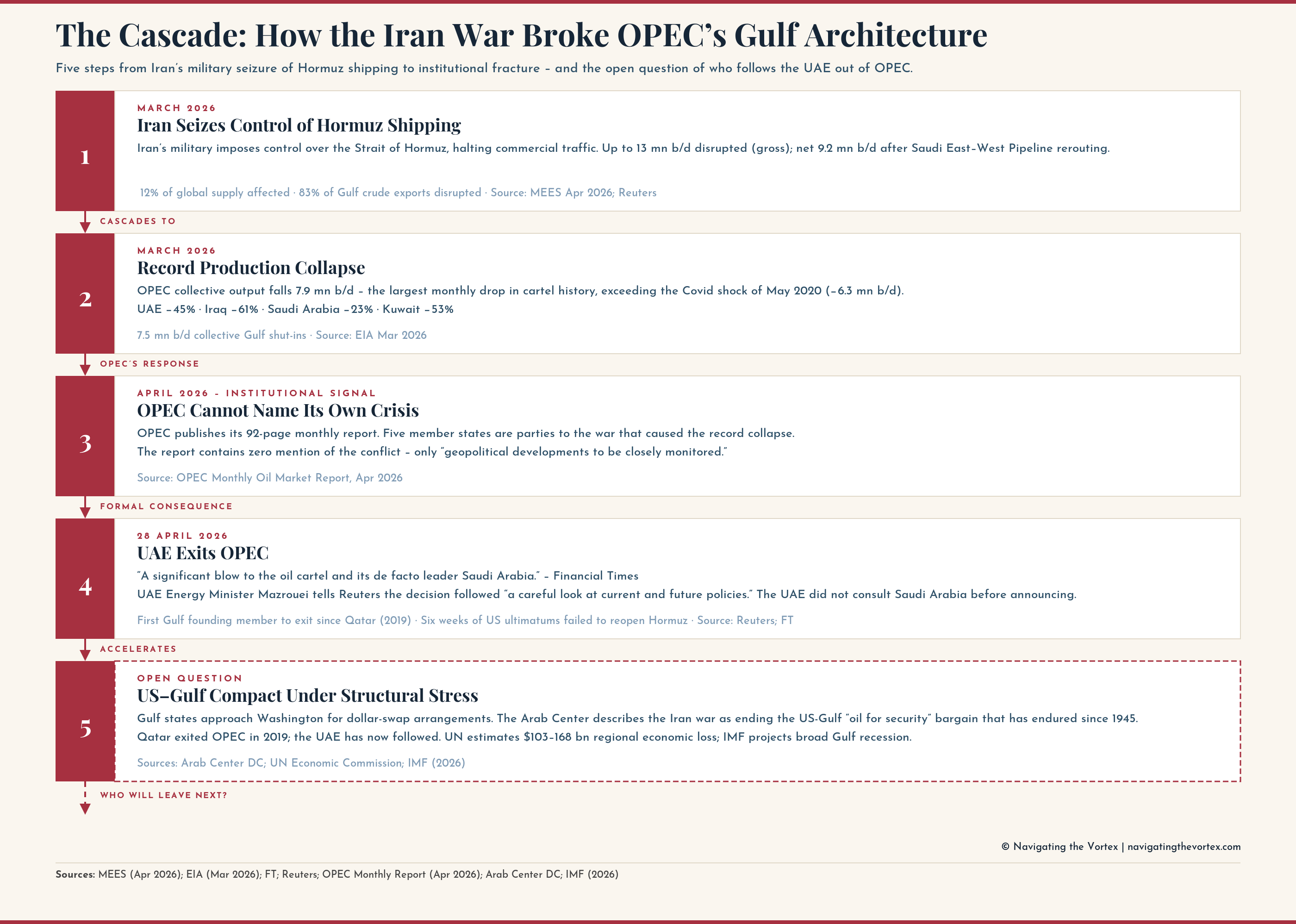
1. OPEC’s institutional collapse is not coming — it is already visible in the organisation’s own documents. In April 2026, the cartel published a 92-page monthly report covering its production without once naming the war that caused its biggest-ever output drop. Five of its members are parties to, or directly affected by, a conflict that reduced the group’s collective production by a record of almost 8 million barrels per day in March, with UAE output falling 45% in that month. This was the largest monthly collapse in the cartel’s history, exceeding even the Covid shock of May 2020.
In its monthly report, the organisation conceded that “geopolitical developments remain an important factor to be closely monitored.” Perhaps it is not surprising that OPEC was unable to use stronger language — after all, Iran, one of the organisation’s founding members, is, for all intents and purposes at war with the other four Gulf OPEC members. But an institution that cannot name the crisis that is destroying its members’ capacity to produce the lifeblood of their economies is not managing that crisis. It has already lost its ability to function. The UAE’s exit is the formal confirmation of the failure that OPEC’s own silence announced first.
“An institution that cannot name the crisis destroying its members’ capacity to produce the lifeblood of their economies is not managing that crisis. It has already lost the ability to function.”
2. The numbers reveal a scale of disruption with unprecedented — and not yet fully appreciated — consequences. While BP doubled its profit in the first quarter, calling conditions “exceptional”, UNDP estimates forecast that the economies of the countries in the Gulf Cooperation Council (GCC) stand to lose between $103 billion and $168 billion. The IMF forecasts a regional recession; only Saudi Arabia is expected to escape it, but not unscathed. The UAE was the first to approach Washington for dollar-swap arrangements; other Gulf states have followed suit.
Oil markets have registered the shock in full: Brent crude rose above $105 a barrel on 28 April before slipping to $104 after the UAE exit was announced — more than 40% above pre-war levels. West Texas Intermediate reached $101. US gasoline hit $4.18 a gallon, its highest since April 2022, up 40% since the war began. Diesel stands at $5.46, up 45%.
3. The UAE’s exit is a direct blow to Saudi Arabia — and that is the more consequential story than the OPEC membership change itself. The Financial Times frames this explicitly: the UAE’s departure is “a significant blow to the oil cartel and its de facto leader Saudi Arabia.”
The two Gulf giants have been on diverging trajectories since at least 2018. The Qatar-linked Arab Center in Washington, D.C., documented the widening fault lines between the UAE and Saudi Arabia before the war. Every one of them has become deeper and more entrenched, making an effective and united response of the Arab Gulf states all but impossible and leading the UAE’s diplomatic adviser Anwar Gargash to describe the Gulf response to Iranian attacks as “the weakest in its history.”
OPEC without Saudi-UAE alignment at its core is a coordination mechanism whose two most important participants are no longer pointing in the same direction — and one has now walked out.
“The UAE’s exit is not the product of Trump’s pressure campaign succeeding. It is the product of UAE frustration with the political vacuum that the campaign left behind.”
4. Trump wins the political framing — but the record of the past weeks tells a different story. The UAE exit will be presented in Washington as vindication of Trump’s pressure campaign against Iran and as evidence that OPEC’s grip on energy markets is breaking. Politically, that framing will hold.
The actual record of Trump’s manoeuvring since the beginning of the war, however, is one of repeated but unenforced ultimatums, escalating deadlines, and threats of strikes on Iranian power plants and energy infrastructure. Deadlines were extended or quietly abandoned as Iran refused to yield.
The UAE’s exit was never the intended result of that pressure campaign. It is the product of UAE frustration with the political vacuum that the US campaign left behind. What’s more, a fragmented OPEC in a wartime energy environment, combined with Gulf states seeking emergency dollar liquidity from Washington, means the US now has more distressed dependants in the Gulf, not fewer obligations. And these obligations will outlast the war. While all Gulf states have seen a drop in exports as a result of Iran and the US effectively both blockading the Strait of Hormuz, Arab states have had to shut down production because of limited storage and re-routing capacities. Iran, by contrast, has significantly more expansive storage capacities, meaning that production shutdowns are less likely in the near future — potentially also enabling the country to take full advantage of a reopening of the Strait sooner than its Arab Gulf rivals.
5. The UAE exit accelerates the fragmentation of the Gulf energy-security order — and OPEC’s own silence confirms that order is already gone. The Arab Center describes the Iran war as ending the US-Gulf “oil for security” bargain that has endured since 1945. The UAE’s OPEC withdrawal is the first institutional consequence of that rupture. But the more revealing signal came earlier: an organisation where five of its members are at war with each other, whose production has suffered its worst-ever monthly collapse, and whose response is to publish a document that does not name the conflict. Qatar exited OPEC in 2019. The UAE has now followed. If the old deal is genuinely over — Gulf states restrain production to keep prices stable; the US provides security — then every remaining Gulf member faces the same calculation the UAE just made.
“The question is not whether OPEC fractures further. It is how quickly.”
The question is not whether OPEC fractures further. It is how quickly. And as the fracturing of OPEC confirms — and accelerates — the collapse of the post-1945 Gulf energy-security order, the next question is what replaces it? And what does the answer mean for the next Gulf state calculating whether OPEC membership still serves its economic and security interests?
You can also listen to the Navigating the Vortex podcast — 87 episodes on Apple Podcasts, Spotify, and Amazon Music. New episodes when the news demands it.