



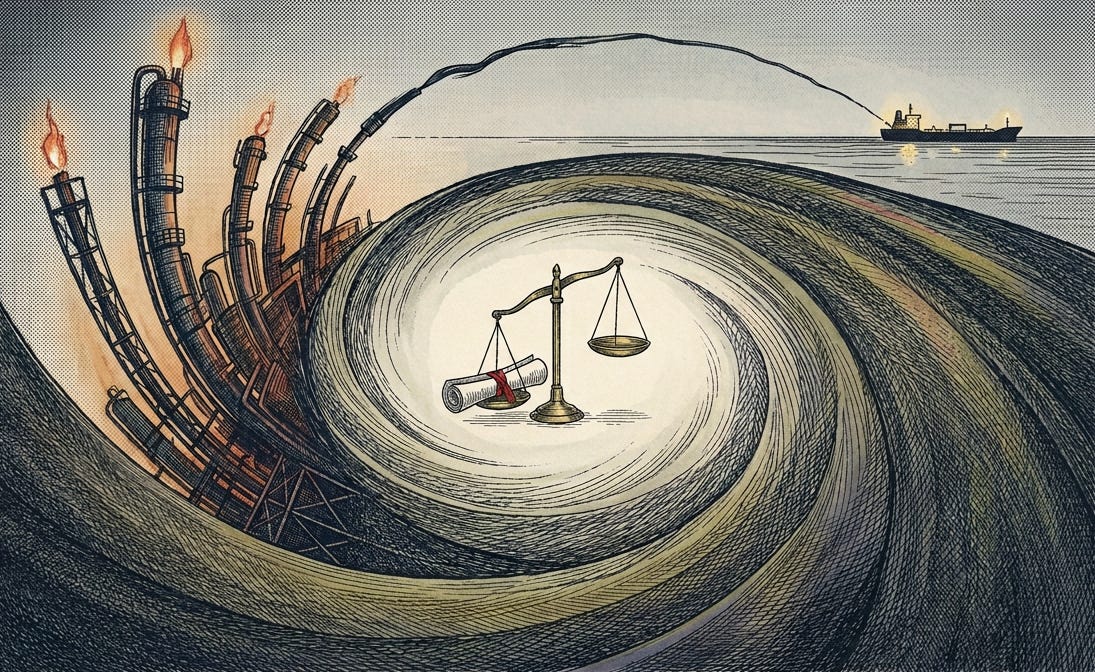
On October 9, US president Donald Trump announced that he had struck a deal with his Russian counterpart, Vladimir Putin, to allow Russia to “immediately supply” more than 300,000 tons, followed by 500,000 tons in November and several million more thereafter. Within hours, the US Treasury issued General License No. 135, authorising the sale, delivery and importation of Russian-origin diesel, “including importation into the United States”, until April 7, 2027.
The deal itself is a major departure from US policy towards Russia and runs counter to Ukrainian and European interests. Adding insult to injury, Trump’s announcement happened as a senior Ukrainian and European delegation sat down with his envoys, Steve Witkoff and Jared Kushner, in Miami for talks to discuss apparently new US proposals, including on a pre-winter deescalation. Once in the room, the US envoys reportedly signalled that sanctions relief was coming, but this still left Ukrainian and European officials blindsided by the announcement. Unsurprisingly, the talks ended the same day without any agreement and a day earlier than planned.
If the diesel deal between the US and Russia was just about fuel, it would be modest at best. The first two tranches in Trump’s announcement amount to just under six million barrels, roughly a day and a half of US diesel demand based on data from the US Energy Information Administration. This will hardly have any significant impact on global diesel supplies, even if Russia can provide the volumes in Trump’s announcement. This, however, is already in doubt given that the lack of Russian diesel exports is primarily due to an export ban imposed by the Kremlin, extended in July but partly lifted for refineries from September, and the rise of diesel prices began with, and is primarily a result of, Trump’s war against Iran.
As part of a domestic price campaign ahead of crucial mid-term elections in the US in early November, Trump’s deal with Putin is unlikely to have a major impact. Its effect on the war, however, is likely to be considerably larger and more damaging.
Ever since Trump’s return to the White House in January 2025, there has been a question about how impartial a mediator between Kyiv and Moscow Washington can and wants to be. With an obvious stake in the output of Russian refineries, this question has now been answered and not in the way any official in Kyiv or its partner capitals had hoped.
In the past, Trump’s approach to ending the Russian war against Ukraine was to try and bully especially Kyiv into concessions to bridge the gap between the stated war aims of both sides.
These attempts largely failed: Ukraine and its European allies rejected the idea of territorial concessions to Russia. Trump’s diesel deal is another attempt to bully by now pressuring Ukraine to give up one of its recently most effective tools: a long-range drone and missile campaign against Russian refineries, which has reportedly caused Russian refining capacity to fall by up to 60% over recent months, while Ukraine’s general staff claims to have put more than 45% of Russia’s refining capacity out of operation.
The diesel deal now caps efforts by Washington to stop targeting Russian refineries since at least September when Trump blamed Ukraine for high diesel prices and urged Zelensky to halt the strikes on Russian refineries. Later in the month, Trump also told reporters that he had asked Zelensky to “take it easy on the refineries”.
Kyiv’s position in this regard has been consistent. As Zelensky said again after Trump announced his diesel deal, “Ukraine will not set Russian oil refineries on fire if Russia does not destroy our energy infrastructure”.
By contrast, Moscow’s terms were different. When Trump announced an energy truce between Russia and Ukraine in mid-September, Putin’s spokesman, Dmitry Peskov, said that a halt to refinery strikes would not on its own bring down prices; that would also require the lifting of sanctions on Russian energy export. On September 25, he added that for international markets to be saturated, Russian diesel would have to reach them “without any sanctions, without any restrictions”.
When Trump provided this sanctions relief in his diesel deal on October 9, Putin got the economic half of an energy truce that he really wanted without having to commit to its military half.
On the contrary, while there is nothing in the deal that obliges Russia to stop striking Ukraine’s grid, Ukraine’s campaign against Russian refineries now runs directly counter to a declared American interest. Trump is already doubling down on his pressure to get Ukraine to stop striking Russian refineries. On October 10, he told Ukraine to “get a new leader”, and Ukrainian and European officials have said that Washington has threatened to cut intelligence sharing and weapons sales if the strikes continue, a claim denied by the US.
On October 11, Trump then declared an “energy ceasefire” that “both parties have agreed”. Zelensky responded that this “was news for me”. Moscow has not confirmed it either and instead struck Ukrainian power plants after Trump’s post.
Much like the failure of Washington’s push for an energy truce in September, this latest attempt is likely to get nowhere.
It won’t even get near the limited ceasefire covering energy infrastructure and possibly grain shipments that was on the agenda of the Miami talks. Russia has repeatedly dismissed temporary or limited ceasefires in favour of a so-called “comprehensive” settlement, a position reiterated again by Russia’s foreign minister, Sergey Lavrov, in his speech to the UN Security Council on September 23.
With neither Moscow nor Kyiv making any significant gains in the ground war, offering any concessions that would signal a breakthrough in future negotiations, nor achieving any decisive advantage in their respective air campaigns, the economic front of the war has become more important again, including in terms of adding strain to already fragile transatlantic relations. The EU’s foreign policy chief, Kaja Kallas, condemned the diesel deal saying that “suspending sanctions on Russian diesel provides Moscow with more revenues to wage war” and that this was “not the time to ease pressure on Russia, and Europe won’t.”
But Europe now depends more on US diesel than it did in the past, and Washington had already threatened export bans to the continent before ruling them out after European concessions. This obvious vulnerability will likely limit how hard Europe will push back. Together with the Treasury licence granted for Russian diesel, Europe’s dependence on energy imports from the US also puts a question mark over how effective and sustainable the EU’s next sanctions package will really be.
Meanwhile, the war continues in the air and on the ground and a pathway to a comprehensive settlement remains just as absent as it did before the diesel deal on October 9. Even a partial deal on energy may now be harder to reach which will add yet more pain and suffering for Ukraine.
Most worrying in the long term, all the signs are that under Trump the US is closer to Moscow’s position than at any point since the full-scale invasion.
This analysis draws on Stefan Wolff’s article published in The Conversation on 12 October 2026.
If Washington’s licence for Russian diesel now runs to April 2027, what leverage does Europe still have to keep Russia’s energy revenues under pressure — and will it use that leverage while it depends on US diesel to get through the winter?
Commenting is open to every subscriber, free or paid — joining takes ten seconds and costs nothing.
Thank you for reading Navigating the Vortex. If you find it useful, the chances are someone you know would too. Refer them — the more people who sign up through your link, the more complimentary access you earn.