



The New York Times mistakes a rebrand for a transformation. The relationship between Trump and Infantino is not one of influence but rather a meeting of the minds. I diagnosed FIFA’s corruption as structural in 2014 and warned a new president would not alter it. No one fixed the structure with any permanence — and the people who could have were put on the payroll. For anyone who sits on a board or vets a partner, the mechanism of capture is the same — and the governance diagnostic is the same too.
The New York Times published a careful, well-reported account of how Gianni Infantino spent years courting Donald Trump — but it has made the wrong call on the chicken and egg of it. The paper calls it the Trumpification of FIFA: a self-invented peace prize pressed into the president’s hands, a flirtation with a FIFA cryptocurrency, hotel-licensing deals stamped with the FIFA name, a gleaming new hub in Miami. Since publication, the relationship has produced its most concrete demonstration yet: a mid-tournament phone call that got a red card against a U.S. player reversed within a day. The reporting is sound, but the framing is wrong.
This is not the story of an upstanding institution being distorted. It is the story of an institution finding its level. FIFA did not contract Trumpism like a virus. FIFA is a body that was already transactional, already self-dealing, already a black box that wrote its own rules. It looked at this White House and recognised an institution resonating on its frequency. This is not a transformation. It is a homecoming.
The diagnosis, a decade early
I can be certain about this, because I wrote FIFA’s diagnosis down more than a decade ago — and not in a place the people who ran football could claim to have never seen it. It ran in translation, too — in Arabic, Chinese, French, German, Russian and Spanish, and a piece on the working conditions in Qatar was also translated into Italian.
In 2014, in my column for Project Syndicate, I urged FIFA to fire Sepp Blatter and rebuild its governance from the ground up, calling the organisation a black box that believed itself “immune from scrutiny” and free to “play by their own rules.” In Fortune, I wrote that the charges had not “come out of nowhere” — that FIFA “has been getting progressively worse for years,” in plain sight, while its sponsors wilfully looked away. And in a BBC column that also appeared in the World Economic Forum’s own publication — set, in other words, in front of the very executives, ministers and heads of institutions who could have forced change — I spelt out exactly what fixing it would take: an independent investigation by people the incumbents did not choose; the chair and chief-executive roles split apart; hard term limits; genuinely independent directors in the room.
I also wrote the sentence I want on the record now. Electing a new president, I warned, “won’t be enough.” Nothing short of root-and-branch structural change would do. I said it then. It came to pass — to the letter.
How much there was to fix
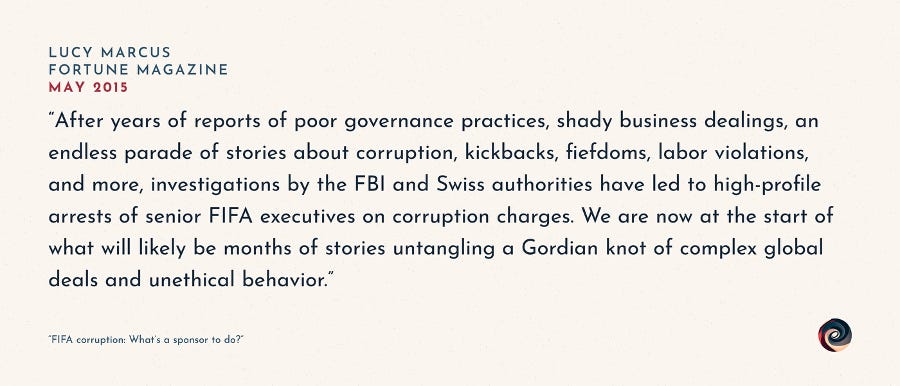
It is worth remembering how much there was to fix. In May 2015, Swiss police walked into the five-star Baur au Lac hotel in Zurich and led FIFA officials out through the lobby. The United States Department of Justice unsealed a sweeping racketeering case: more than 150 million dollars in bribes and kickbacks across nearly a quarter-century, dozens of officials and executives charged, the statute written for the Mafia turned on the governing body of the world’s game. Blatter — president since 1998 — was re-elected days later, then pushed toward the exit; within months he and his heir apparent, Michel Platini, were banned from football for eight years. The bidding that sent the World Cup to Russia and to Qatar left a stain that has never washed out. This was not a handful of bad actors. It was the operating system.
Reform on paper, kabuki in practice
Into that wreckage stepped a new president promising to clean house. Infantino arrived in 2016. The promise was reform. What FIFA delivered was a kabuki performance of reform.
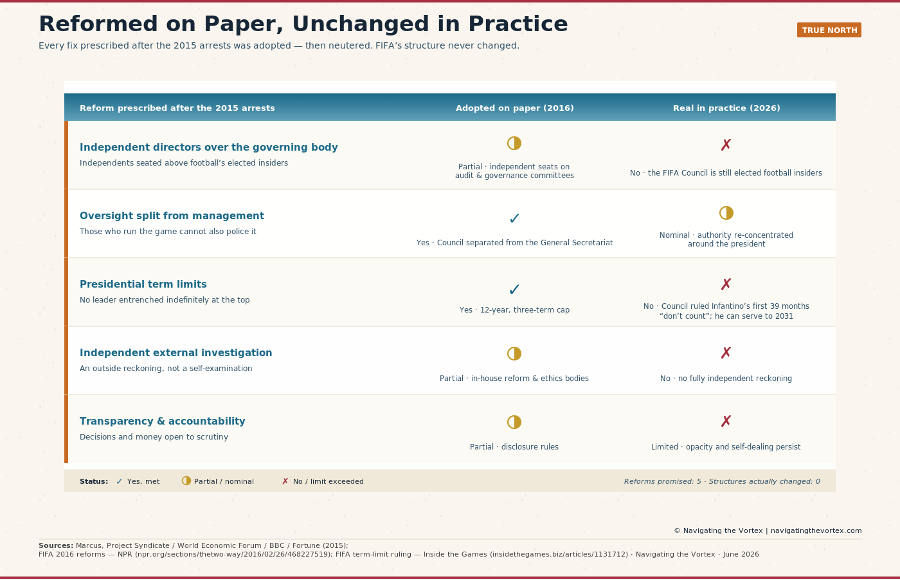
Let the record show that FIFA did pass reforms in 2016: a twelve-year limit on the presidency, a formal split between the Council that sets strategy and the General Secretariat that runs the business, independent members on its committees, new disclosure rules. On paper, my checklist was answered. In practice, almost none of it changed the organisation. The Council is composed of elected football insiders; power is pooled, as ever, around the man at the top. And when the one hard rule met that man, the man won: in 2022, FIFA’s own Council ruled that Infantino’s first thirty-nine months “did not count” toward the term limit, clearing him to rule for fifteen years under a twelve-year cap. The structure was repainted, not rebuilt.
Not accidents — a methodology
And the rot did not stop in 2015 — nor did it start there. The decade since reads less like a series of accidents than a methodology, and the method is old: FIFA handed the 1934 World Cup to Mussolini’s Italy and the 1978 tournament to Argentina’s junta, and the 2018 tournament to Putin’s Russia. Sportswashing is bedrock, not a recent habit.
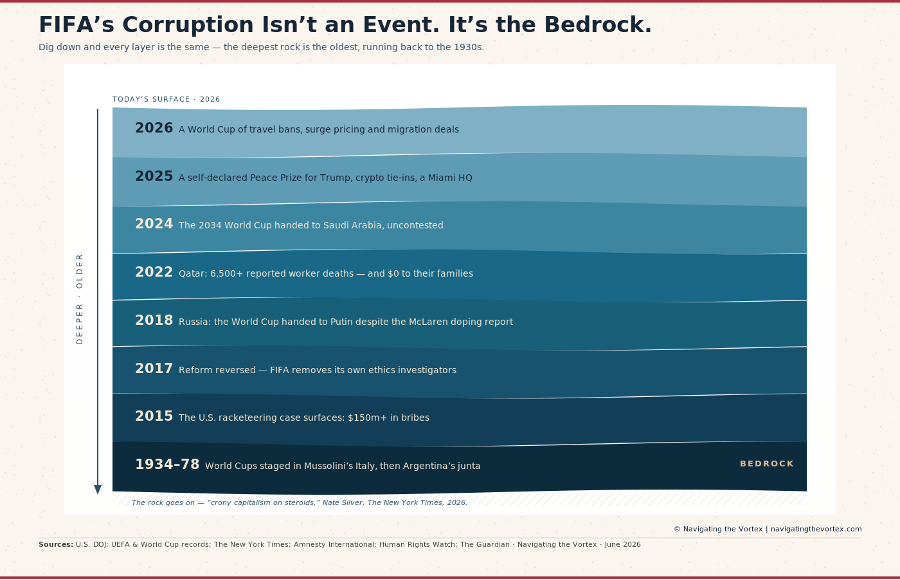
Qatar was sold as the first “carbon-neutral” World Cup, a claim a Swiss regulator ruled false — and the 2034 World Cup was handed to Saudi Arabia without even a contest, on human-rights pledges that Amnesty International warned offered no “credible guarantees of reform.”. The real ledger was human: thousands of migrant-worker deaths in the years of construction, and a FIFA that promised remedy and then delivered a $50 million “Legacy Fund” routed to UN agencies and the World Trade Organization, with nothing for the workers a report it had itself commissioned was understood to recommend it compensate.
Even the doping scandal is, for FIFA, a scandal of looking away. When the McLaren report named Russian football inside a state doping scheme, FIFA investigated its own World Cup hosts and closed the cases against its World Cup players for “insufficient evidence,” then kicked off the tournament in Moscow. FIFA did not dope anyone. It was the body that chose not to look.
And beneath the money sits something worse. Luis Rubiales seized and kissed a player at the 2023 Women’s World Cup final and was later convicted of sexual assault. Federation presidents in both Afghanistan and Haiti were banned for life by FIFA for the sexual abuse of female players. The Afghan ban was upheld on appeal; the Haitian one — where the victims included minors at the national training centre — was quietly overturned by the Court of Arbitration for Sport for “insufficient evidence,” leaving the man free.
Haiti’s team is at this World Cup; its fans are barred at the United States border; the man who abused its girls is not. If you want to know what an organisation truly values, watch what it lets slide.
The electorate on the payroll
So how does a body with this record keep going, decade after decade, scandal after scandal? The answer is almost banal.
Everyone who could discipline FIFA is paid not to — in money or in joy. Sponsors, broadcasters and host governments look away; even we, the fans, get caught up in the beautiful game and find it hard to look squarely at it. Looking would cost more than not looking.
But the machine has a specific engine, and a whistleblower’s account of how Infantino keeps his grip names it precisely. FIFA hands up to $8 million a cycle to each of its 211 member federations through its development programme — and the president controls the flow. The federations elect him; he funds them; they elect him again. He says it unabashedly from the stage: “seventy per cent of you,” he told the 2024 Congress, “would have no football without the resources coming directly from FIFA.” The electorate that is meant to hold the president to account is on his payroll. Reform that never touches the money was never going to bite.
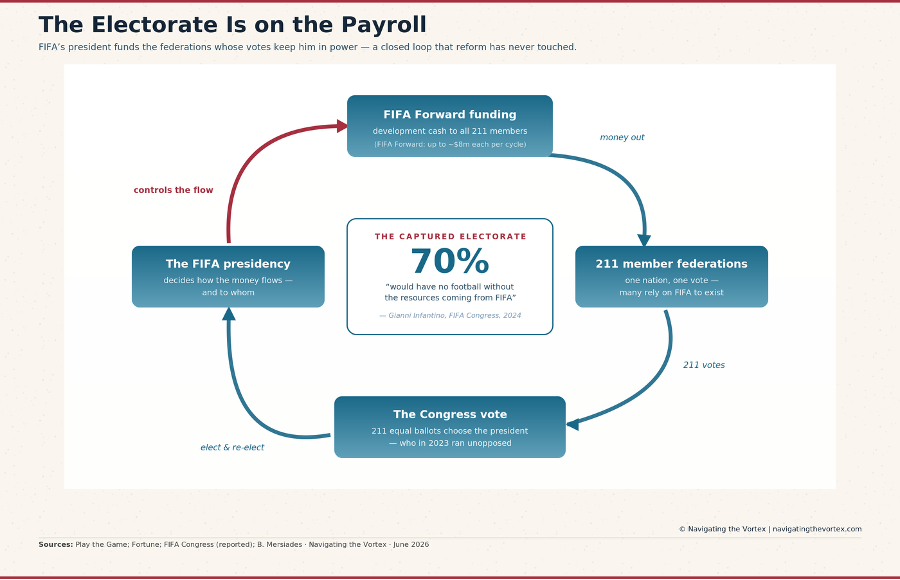
I had named that failure too, back in 2015. Membership organisations governed only by their members, I argued in my BBC column, risk becoming an echo chamber — “a place where the self-interest of individual members overrides actions that are best for the organisation as a whole.” FIFA did not merely prove the point. It industrialised it.
Don’t mistake the man for the machine
Not everyone takes the bait, which is how you can see the machine working. When FIFA came to Chicago, the Mayor at the time, Rahm Emanuel, read the terms and walked. He would not, he said, “allow taxpayers of the city of Chicago to be dumb money,” and told FIFA to “take a hike.” The point is that walking away is the exception. The model is extraction, and it works because almost no one says no. FIFA even courted the Biden administration, which kept its distance, wary of “a scandal-tainted organisation”.
The pattern keeps confirming itself. During the tournament itself, Trump called Infantino directly to ask for a review of a red card against United States forward Folarin Balogun — and FIFA, within a day, lifted the suspension, drawing a furious response from Belgium's football federation, which called the reversal "unprecedented, incomprehensible and unjustifiable." Infantino did not deny the call took place; he said discussing World Cup matters with the U.S. president is something he does "regularly." A financial disclosure the same week showed Trump had accepted fifteen thousand dollars in FIFA tickets from Infantino, days before Infantino confirmed Trump would present the World Cup trophy himself on 19 July. Jürgen Klopp, incoming manager of Germany, put it more bluntly than any official involved: "Let's just say: this is our game, not theirs. These two people, who both have no idea about football, should have nothing to do with that." None of this required a conspiracy. It required only what the captured electorate has always required: a man at the top who understands that proximity to power is worth more than the rules on paper.
The Times is not arguing that FIFA was previously clean; its specific claim is that the Trump relationship represents something new in its particular transactional character. That is true. What the frame gets wrong is the causal direction and the significance.
So when the New York Times reads off Infantino’s flatteries — the peace prize, the FIFA coin, the mooted FIFA hotels — as evidence of a new, Trump-shaped FIFA, it mistakes the surface of a river for the riverbed. Every item is the same organisation doing the same thing it has always done: monetising proximity to power, which is its native art.
This is why the frame is not a quibble. If you believe FIFA is being Trumpified, the cure looks like removing Infantino — a clean new president, a fresh start, the reset. That is the exact error football made in 2015, the error I warned against, and the error that produced the very man the New York Times is now writing about. The disease was never the figure at the top. It is the structure beneath him — and the electorate that structure pays.
For anyone who sits on a board, prices a counterparty, vets a partner, signs off on a sponsorship, the lesson travels far beyond football. Learn to tell reform from rebranding. Reform changes the architecture: independent oversight, separated powers, term limits that bind the people who wrote them, money that cannot be turned into votes. Rebranding changes the letterhead and the friends in the photographs. When an organisation tells you it has turned a corner, do not count the new faces or admire the new mission statement. Ask whether a single line of the governance has changed and proof of genuine follow through — and whether the rules still bind the person at the top. Often enough they do not, and the company an institution keeps will tell you long before its accounts do.
The New York Times is right that FIFA is being remade in a powerful man’s image. It simply has the wrong man. FIFA was ever thus — in Zurich, in Moscow, in Doha, and now at Mar-a-Lago. It promised reform, it even legislated reform, and it counted on the world moving on. The world’s tolerance for naked self-dealing moved instead, and FIFA walked through without lowering its voice. Until someone rebuilds the architecture — and frees the electorate from the purse — the patron will keep changing and the organisation will not.
In your own governance experience — on a board, as an investor, or inside an institution — have you seen the funding relationship and the oversight function collapse into the same hands? What made it hard to separate them once it had happened?
We hope you’ll share Navigating the Vortex with anyone you think might find it of interest. Also, you can listen to our podcast editions via the website and on all major podcast platforms, including Apple Podcasts, Spotify, and Amazon/Audible.