




On 1 September, the Shanghai Cooperation Organisation marked its 25th anniversary in Bishkek with all the trappings a diplomatic milestone demands: 21 heads of state and government, a ceremonial family photo, and a two-page Bishkek Declaration plus 28 other agreements on everything from synthetic-drugs coordination to biodiversity conservation. Xi Jinping, Vladimir Putin and Narendra Modi were all present, alongside Pakistan’s Shehbaz Sharif, Iran’s Masoud Pezeshkian and Turkey’s Recep Tayyip Erdoğan. On the face of it, and looking at the communiqué in particular, the SCO looks like a confident bloc speaking with one voice for roughly a quarter of humanity and a quarter of global GDP.
The real picture, however, is rather different and far less flattering. A quarter of a century in, and the SCO remains primarily a forum for multiple parallel bilateral engagements and dealmaking between leaders. So far, so functional. What the SCO has never been in this quarter-century is a body able to adjudicate the disputes its members bring to the room, still less the ones they keep outside.
At its best, the SCO has been something narrower: a shell for bilateralism, a stage that lets its most powerful members, in particular, strike deals and settle scores one-on-one.
As they often do this in very public ways, the messages they send more often than not are for domestic consumption: to present themselves as staunch defenders of strategic national interests.
Take Narendra Modi’s plenary address. With Pakistan’s prime minister Shehbaz Sharif at the same table at the same time, Modi declared that “there can be no place for double standards” in dealing with terrorism and that “terrorism can never be a strategic asset for anyone” while calling for dismantling “the entire ecosystem of terrorist financing, recruitment, radicalisation and safe havens.” He did not need to name Pakistan to make it clear who the addressee was: everyone in the room and at home will have recognised this as the language India uses to criticise Pakistan for its alleged support of transnational terrorist networks. The added benefit of the SCO summit for Modi is that he delivers it directly into Sharif’s face.
Modi then made a second point, noting that it is essential to “respect the sovereignty and territorial integrity of all countries”. Without saying it directly, it works as a rebuke for Russia’s war against Ukraine, for China’s Belt-and-Road corridor through Pakistan-administered Kashmir, and for Pakistan’s claims to territory that India considers its own. A statement like that not only makes Modi look good at home. It also offers something for India’s partners in the west – who can read it as a criticism of Russia – and helps shore up India’s traditional role as a champion of the global south, including against Chinese or Russian aspirations in this regard.
Modi also had a more direct message for Putin which he delivered in person and on the record. “Every day spent in war pushes humanity backwards,” he told the Russian president after their customary hug, before emphasising the need to move “from an endless war towards an end to the war.” While there is clearly a more constructive and less antagonistic bilateral relationship between India and Russia, compared to India and Pakistan, it was nonetheless a notably pointed line to deliver, in public, to a fellow leader of a bloc built partly around the idea that its members offer each other unconditional solidarity against the West. This is not the first time that Modi publicly called on Putin to end the war. He also condemned the deaths of Ukrainian children in a Russian missile strike just as the two leaders had a bilateral summit in Moscow in 2024.
Modi’s interaction with Xi tells yet a different story. It was equally carefully choreographed but much shorter: just a handshake and a short walk together. It was cordial, on the record, but not a formal bilateral meeting. It signalled the continuation of rapprochement without any breakthrough to report, reflecting the outcome of the latest round of boundary negotiations between the two countries in Beijing on 25 August: an agreement to keep talking and nothing else.
These three interactions capture something broader about the nature of SCO summits: the organisation’s members, and especially the ‘big three’ of China, India and Russia, are using the SCO stage to project their own foreign policies, not to subordinate them to any kind of collective agenda.
Putin came to Bishkek with the busiest bilateral schedule of any leader — nine meetings across two days, including with Xi, Modi, and Pezeshkian, and the presidents of Tajikistan, Mongolia, Kyrgyzstan, Kazakhstan, and of attending non-SCO members Türkiye and Armenia.
Impressive as Putin’s SCO agenda may seem, it is hardly a sign of strength and smacks more of necessity and desperation.
Because of the ICC arrest warrant against him, Putin’s personal diplomacy is now confined to venues like the SCO and sometimes the BRICS. This is hardly a good look for the leader of a would-be great power who has also suffered recent setbacks in its influence and leverage elsewhere, from Syria to Venezuela to Mali.
Xi, by contrast, was strikingly selective, with his only confirmed bilateral meeting being with Putin. This can be seen as a possible signal that Beijing increasingly views the SCO as a lower-value venue than its own direct channels with individual capitals or forums like the BRICS. In this context, it was also striking that Xi then headed straight to Cairo for his first state visit there in a decade, and thus to a country that has been a member of the enlarged BRICS since 2024, ahead of that organisation’s upcoming summit in New Delhi on September 12 and 13.
Each of the organisation’s ‘big three’ is extracting something different and specific from the summit, none of which depends on the SCO functioning as a collective actor.
This is particularly evident again in the Bishkek Declaration. Although framed as a celebration of the organisation’s 25th anniversary, the declaration and its accompanying set of 28 agreements simply entrenches the kind of relatively low-level, smallest-common-denominator cooperation SCO members have signed onto for years and rarely, if ever, operationalised in any meaningful way: protocols on cross-border crime, a synthetic-drugs coordination initiative, a drug-addiction cooperation programme, an information-security programme to 2028, biodiversity commitments, a green technology corridor. On the contentious issues – terrorism, boundaries, the war in Ukraine – the declaration is mostly silent. Its mention of the “great potential to further improve cooperation in the fight against terrorism, separatism and extremism” is hardly a display of members’ genuine enthusiasm in this regard.
This is SCO business as usual and hardly the worst of its kind. In September 2022 exactly at the time of the SCO summit in Samarkand, Kyrgyzstan and Tajikistan – founding members of the SCO in 2001 and its predecessor, the Shanghai Five, in 1996 – were shelling each other along their border in one of the deadliest clashes of a dispute that had already killed dozens the previous year. Despite a death toll close to 100, and well over 100,000 people displaced, the 19-page Samarkand Declaration said nothing about it.
The way that this dispute was resolved points to a larger issue for the SCO as well. In 2022, the fighting was stopped after Putin phoned his Kyrgyz and Tajik counterparts separately, and these two leaders eventually settled their dispute in 2025 through direct negotiations. Thus, much like the China-India boundary negotiations, not only was the process of resolving the dispute between SCO members bilateral in nature, but it also happened completely outside the organisation. And this is a pattern throughout the organisation’s history.
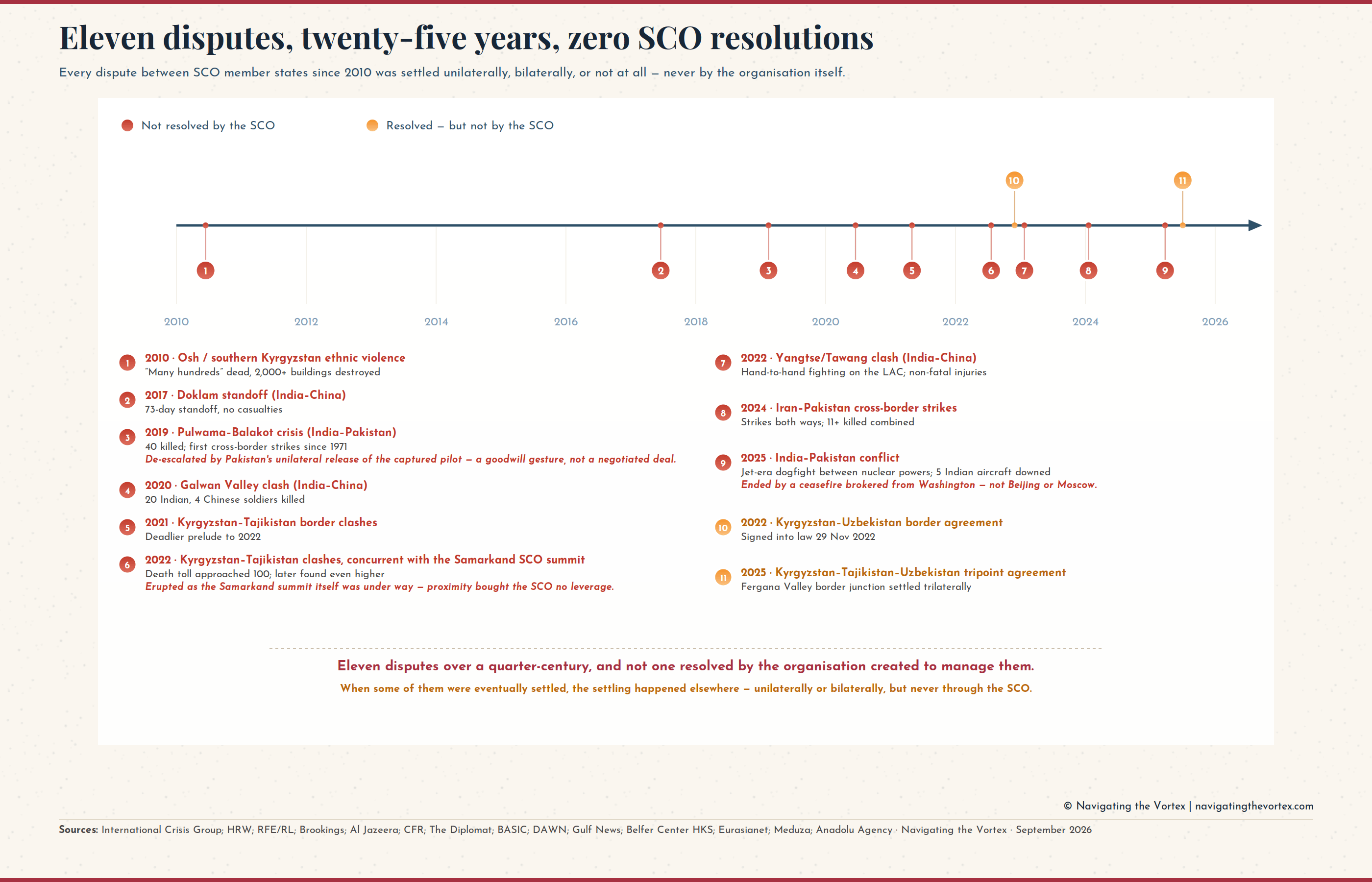
None of this means the SCO is meaningless. Its summits generate bilateral engagements, agreements, and opportunities for its members to project non-Western solidarity to their own domestic and international audiences. But Bishkek’s real anniversary message was not the declaration its leaders signed but the affirmation of the ordinary, practised way in which the organisation’s three dominant leaders – Xi, Modi and Putin – used the same forum to pursue three entirely separate agendas and left having resolved none of the issues that divide them. The Bishkek summit points to yet more bilateralism happening outside – not inside – the SCO’s shell.
This analysis is an extended version of Stefan Wolff’s article published in The Conversation on 4 September 2026.
If the SCO can’t even mediate a violent dispute between its own founding members, is “strategic autonomy” really what member states get from it — or just cover for pursuing bilateral interests they would pursue with or without the forum?
Commenting is open to every subscriber, free or paid — subscribing takes ten seconds and costs nothing.
Thank you for reading Navigating the Vortex. If you find it useful, the chances are someone you know would too. Refer them — the more people who sign up through your link, the more complimentary access you earn.
You can listen to our podcast editions via the website and on all major podcast platforms, including Apple Podcasts, Spotify, and Amazon/Audible.