




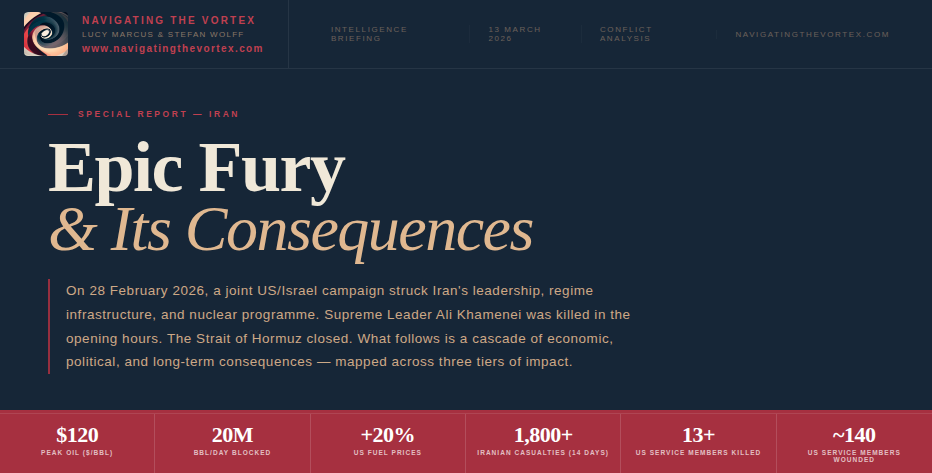
On 28 February 2026, the United States and Israel launched a joint military campaign against Iran — striking its leadership, regime infrastructure, and nuclear programme in the opening hours. Supreme Leader Ali Khamenei was killed. Within a few days, the Strait of Hormuz was closed. Oil spiked to $120 a barrel.
We have spent the days since working through what this means — not just for the Middle East, but for energy markets, food systems, the global financial order, nuclear non-proliferation, and the wider trajectory of the Russia–Ukraine war. The consequences are cascading in real time, and the full effects will play out over years, not weeks
Below is our full analysis so far, structured across three tiers: the direct and immediate impacts; the secondary geoeconomic and geopolitical shocks; and the longer-term butterfly effects that this war has already set in motion.

Tier One: Primary Impacts — Direct & Immediate
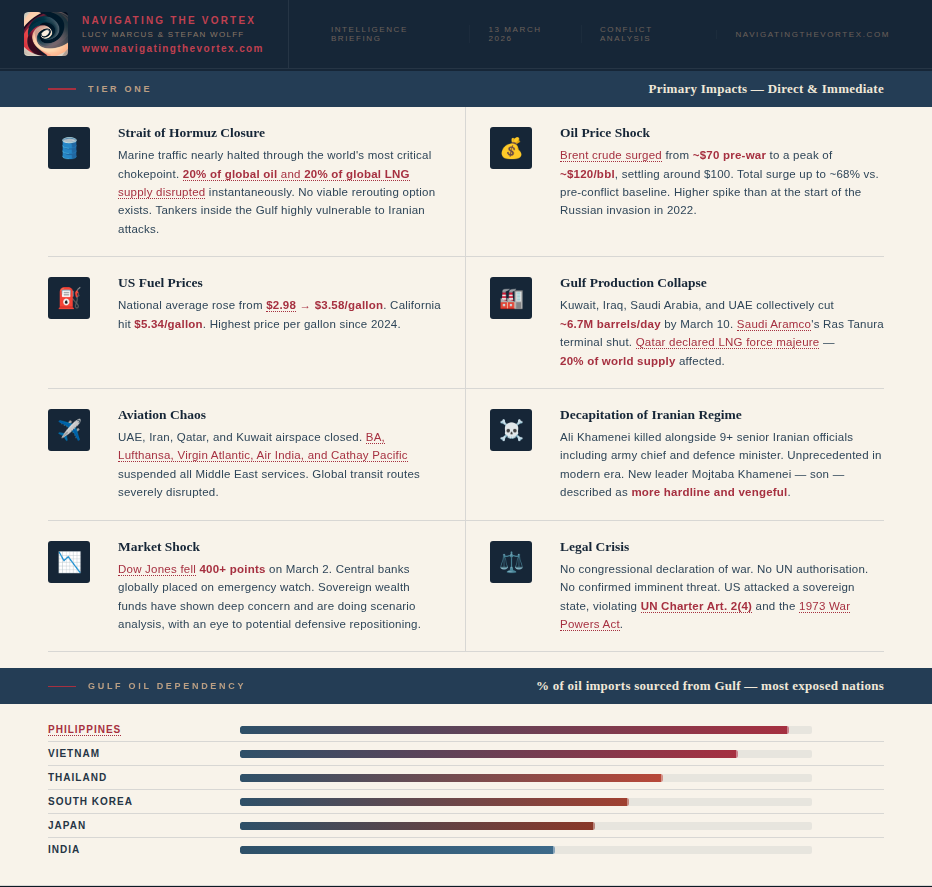
Strait of Hormuz Closure
20% of global oil and 20% of global LNG supply transits the Strait of Hormuz daily. There is no viable rerouting option for tankers caught inside the Gulf, and with Iranian forces actively targeting maritime traffic, marine transit has nearly halted through the world’s single most critical energy chokepoint.
Oil Price Shock & Fuel Prices
Brent crude surged from roughly $70 per barrel pre-war to a peak of $120, settling around $100 — a spike larger than the one that followed Russia’s invasion of Ukraine in 2022. At the pump, Americans saw the national average rise from $2.98 to $3.58 per gallon, with California hitting $5.34. That is the highest price per gallon since 2024.
Gulf Production Collapse
Kuwait, Iraq, Saudi Arabia, and the UAE collectively cut production by approximately 6.7 million barrels per day by 10 March. Saudi Aramco’s Ras Tanura terminal — one of the largest oil export facilities on earth — was shut. Qatar declared LNG force majeure, instantly affecting 20% of world supply.
Aviation Chaos
The airspace of the UAE, Iran, Qatar, and Kuwait closed simultaneously. British Airways, Lufthansa, Virgin Atlantic, Air India, and Cathay Pacific all suspended Middle East services, with knock-on disruption across global transit routes that will take time to resolve.
Decapitation of the Iranian Regime
Ali Khamenei was killed alongside nine or more senior officials — including the army chief and defence minister. This is unprecedented in the modern era. His son, Mojtaba Khamenei, has stepped into the leadership vacuum and is described by analysts as more hardline and vengeful than his father. The regime has not collapsed. It has radicalised.
Market Shock & Legal Crisis
The Dow Jones fell more than 400 points on 2 March. Central banks globally were placed on emergency watch, with sovereign wealth funds doing urgent scenario analysis. On the legal front: there was no congressional declaration of war, no UN authorisation, and no confirmed imminent threat. The US attacked a sovereign state, raising serious questions about violations of UN Charter Article 2(4) and the 1973 War Powers Act.
Tier Two — Secondary Economic Impacts

Inflation & the Stagflation Spectre
The IMF formula holds that every 10% rise in oil prices produces approximately +0.4% global inflation and −0.15% GDP growth. With oil up nearly 70% from pre-conflict levels, those numbers are not academic. Central bank governors are openly citing the 1970s stagflation episode as the relevant historical parallel — a period from which recovery took a decade.
Food Price Shock
This is the underreported story. 30% of global fertiliser exports transit the Strait of Hormuz. The shipment cutoff translates directly into higher farm production costs, with downstream food price rises expected within six to ten weeks in import-dependent nations. The food shock will outlast the oil shock.
Developing World Crisis
The Philippine peso has dropped to 59.5 PHP/USD, while diesel prices surged +38.6% in the country. Egypt declared a near-emergency. South Korea, Thailand, Bangladesh, and Pakistan have all introduced price caps and fuel rationing. The countries least responsible for this conflict are bearing some of its highest costs.
Europe on the Brink of Recession
European gas prices nearly doubled. The continent is still rebuilding its energy architecture following the decoupling from Russia, with strategic reserves currently limited. The IEA agreed to a strategic release of 400 million barrels of reserves, the largest in history.

The Fed is Caught
The US Federal Reserve faces the classic stagflation trap: cutting rates risks accelerating inflation; raising them risks deepening an employment downturn. Both actions carry severe risks simultaneously, and there is no clean exit from this position.
Tariff Shock Compounding
The Iran war compounds the pre-existing tariff shock from Trump’s trade policy. American households now face simultaneous energy cost spikes and supply chain disruption — a double-squeeze not seen since the 2008 financial crisis.
Tier Two — Secondary Political Impacts
Russia Wins the Lottery
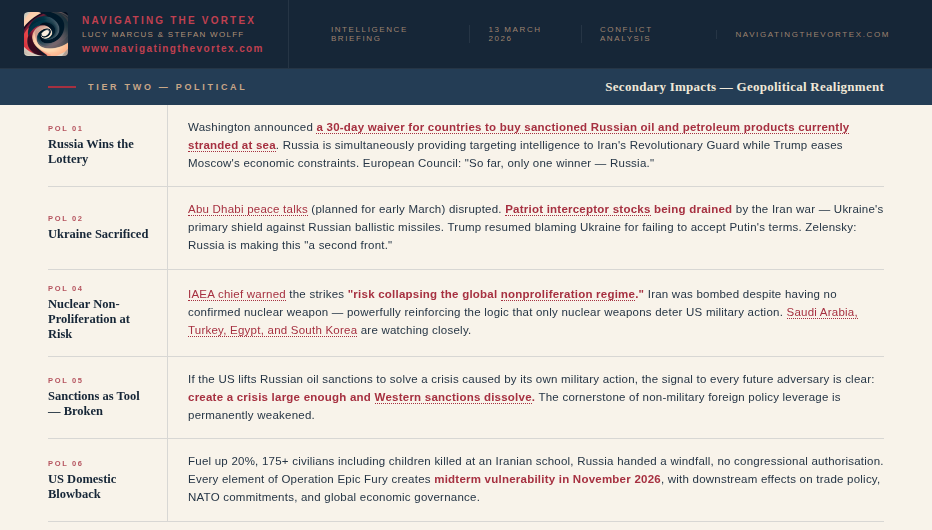
Washington announced a 30-day waiver for countries to buy sanctioned Russian oil and petroleum products currently stranded at sea. Russia is simultaneously providing targeting intelligence to Iran’s Revolutionary Guard while having its economic constraints eased by the US. The European Council’s assessment is blunt: “So far, only one winner — Russia.”
Ukraine Sacrificed
Abu Dhabi peace talks planned for early March were disrupted. Patriot interceptor stocks — Ukraine’s primary shield against Russian ballistic missiles — are being drained by the Iran war. Trump has resumed blaming Ukraine for failing to accept Putin’s terms.
Nuclear Non-Proliferation at Risk
The IAEA chief warned that the strikes risk collapsing the global non-proliferation regime. Iran was bombed despite having no confirmed nuclear weapon. The lesson this writes for every other state watching — including Saudi Arabia, Turkey, Egypt, and South Korea — is devastatingly simple: only nuclear weapons deter US military action.
Sanctions as a Tool — Broken
If the US lifts Russian oil sanctions to solve a crisis caused by its own military action, the signal to every future adversary is permanent: create a crisis large enough and Western sanctions dissolve. The cornerstone of non-military foreign policy leverage has been weakened, possibly fatally.
US Domestic Blowback
Fuel up 20%. Over 1,800 Iranians killed in the first 14 days, including children at a school. Russia handed a windfall. No congressional authorisation. Every element of Operation Epic Fury creates midterm vulnerability in November 2026, with downstream effects on trade policy, NATO commitments, and global economic governance.
Tier Three — Butterfly Effects and Long-term Consequences

Taiwan Challenge
Two US navy aircraft carrier groups are in the Persian Gulf. Patriot stocks are dangerously down. US political capital is consumed. The Taiwan Strait is less defended than at any recent moment. If the Iran war extends past summer 2026, the window of reduced US Pacific capacity becomes strategically tempting to Beijing. China is treating every engagement against US carrier strike groups as live-fire doctrine refinement for a Taiwan scenario.
Nuclear Proliferation Cascade
The lesson that nuclear weapons are the only insurance policy against a US attack is now written in fire over Tehran. Saudi Arabia, Turkey, Egypt, and South Korea have all previously signalled nuclear hedging interest. If the non-proliferation regime collapses, the world twenty years hence is fundamentally more dangerous.
Russia’s War on Ukraine Gets Longer
Higher oil revenues, eased sanctions, diverted US military attention, depleted Patriot stocks, stalled peace talks, European financial support for Ukraine under strain — every variable moves in Russia’s favour. Russia benefits from Iran bleeding US and allied forces and drain interceptor stocks. The Iran conflict is likely to make Russia’s war on Ukraine both longer and harder to resolve.
Energy Transition Leap
This is the one consequence that cuts differently. The oil price spike makes renewables dramatically more cost-competitive. European and Asian governments will likely accelerate domestic clean energy investment regardless of climate politics. Long-term losers: petro-states. Long-term winners: clean energy industries and the fastest-moving economies.
Key Variables — Determining the Severity of Outcomes
Whether the Strait of Hormuz remains closed
Whether Iran’s regime collapses, escalates, or seeks negotiation
Whether IEA release of strategic reserves at historic scale calms or spooks markets
Whether the US can feasibly escort tankers through the Strait of Hormuz
Whether conflict spreads via Lebanon, Gaza, Iraq, or Yemen proxy escalation
Whether Russian sanctions relief becomes permanent
Whether Ukraine talks can resume
Whether China interprets US overextension as a strategic window in Taiwan
Whether ceasefire terms preserve or further degrade the IAEA non-proliferation framework
Whether the US recommits to non-proliferation diplomacy or accelerates NPT regime collapse
We will continue to track this as it develops. The situation remains highly fluid — the Strait of Hormuz closure, the Iranian political transition (if any), the status of Ukrainian air defences, and the position of the Gulf states are all moving simultaneously. The range of possible outcomes from here is exceptionally wide.
If this analysis is useful to you, please share it. These are the kinds of moments where clear-eyed mapping matters more than noise.
📄 Download the full report — The complete infographic, with hyperlinks is available as a PDF below. It is formatted for sharing and printing.

We hope you’ll share Navigating the Vortex with anyone you think might find it of interest. Also, you can listen to our podcast editions via the website and on all major podcast platforms, including: