



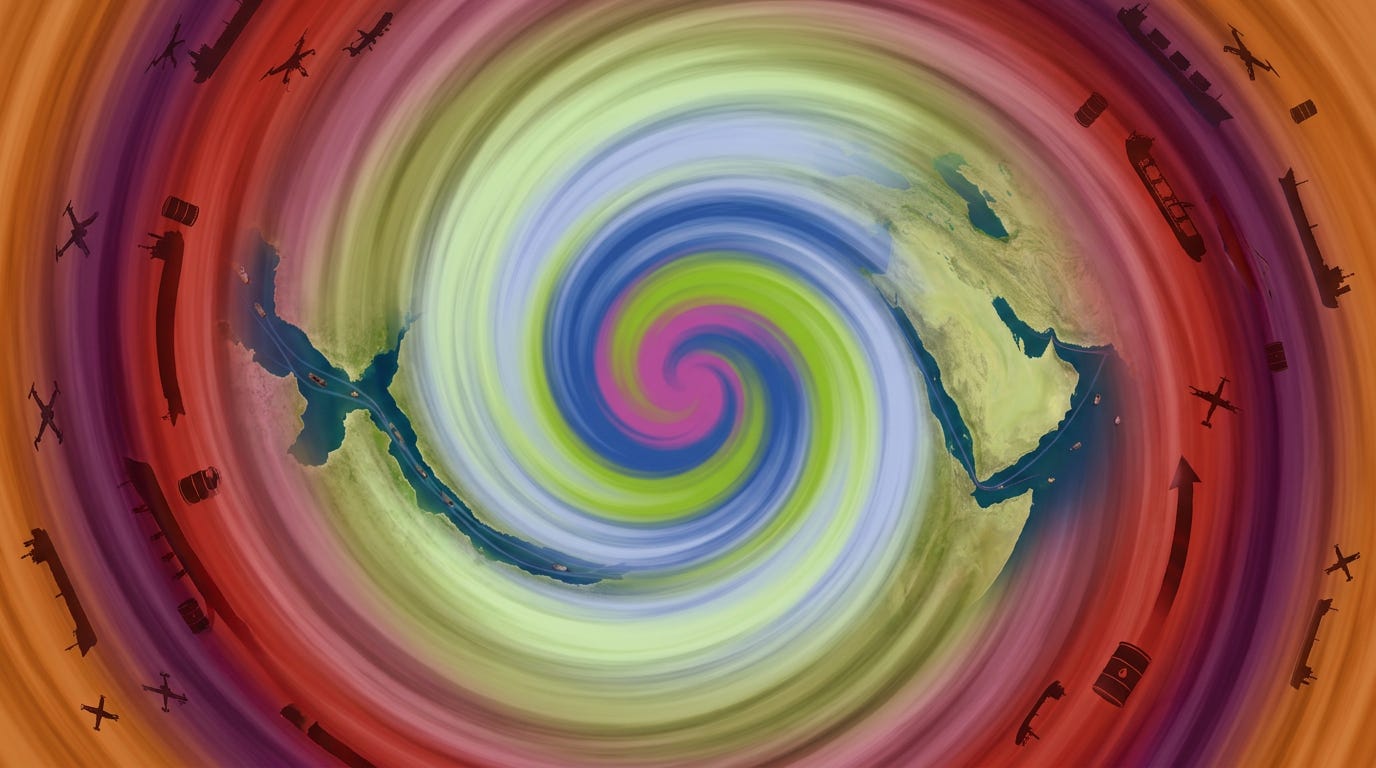
When the Iran war erupted at the end of February 2026, Vladimir Putin appeared to be its biggest winner. Soaring oil prices, diverted Western attention and US military assets — they all seemed to strengthen the Russian president’s hand in his war against Ukraine.
That price shock did not come from a single chokepoint. Brent crude spiked twice in five months — once when the Strait of Hormuz closed, and again in July when a ceasefire collapsed and Houthi attacks widened the disruption to the Bab el-Mandeb strait.
But the longer the US-Israel war against Iran has dragged on, the more Ukraine has found ways to make itself strategically useful beyond its own battlefield, diminishing the benefits that Russia reaps.
While the world’s attention was on the Strait of Hormuz and the Red Sea, Ukraine struck Iranian cargo ships and their Russian navy escort in the Caspian Sea, which borders both Russia and Iran, on 25 July 2026.
The connections between the two wars are not new. They go back to the drone-and-munitions trade that began almost as soon as Russia’s invasion of Ukraine stalled in 2022.
Since then, Russia and Iran signed a Comprehensive Strategic Partnership Treaty on 17 January 2025; it entered into force on 2 October 2025 after ratification. The treaty establishes a 20-year framework covering defence, energy and finance, though it is still short of a NATO-style mutual-defence clause.
The relationship between Russia and Iran has also become operationally deeper than the long-established weapons trade. According to Ukraine’s president Volodymyr Zelensky, Russia has been providing Iran with real-time intelligence support, including satellite surveillance of US positions in the Gulf that has reportedly aided Iranian targeting. Russia has denied the allegation, but if Zelensky’s account of it is accurate, providing this kind of operational battlefield support would pit Moscow more directly against Washington and its regional allies in the Iran war.
This is also the case with drones. These remain a critical link between Russia and Iran, but the direction of the relationship has changed. Moscow initially relied on Iranian Shahed-136 drones after its invasion of Ukraine stalled in 2022. In a striking reversal, Russia is now reportedly supplying Iran with drone components and upgraded Geran designs based on the original Shahed technology, after Iran lost a large share of its own arsenal in the 2026 war.
But the deepening Russia-Iran partnership also has vulnerabilities. First, it has lost its human anchor. Ayatollah Ali Khamenei — for a quarter of a century Putin’s stable interlocutor in Tehran — was killed alongside much of Iran’s senior leadership in the joint US-Israeli strikes that opened the 2026 Iran war on 28 February.
Then, Moscow’s failure to intervene militarily when its partner got in trouble echoes the collapse of its protection of Bashar al-Assad in Syria — a reminder that Russian “protection” for its clients is rhetorical rather than real.
At the same time, Ukraine has found ways to exploit the Russia-Iran relationship and strengthen its own standing with the US as a result.
Based on years of experience dealing with Russian-Iranian drones, Kyiv sent military experts to the Gulf to help the US, Israel and their Gulf allies counter such attacks.
Ukraine’s latest Caspian Sea strike also targeted the Iran-Russia supply chain directly, in contrast to earlier attacks against just Russian naval assets. The flow of critical drones and drone components into Iran is now under direct threat.
Both countries’ wider maritime logistics — above all, the parallel “shadow fleet” tanker networks, roughly 591 Russian-linked vessels and 170 Iranian, that the two countries use to evade US and EU oil sanctions, sharing insurers, flag registries and falsified documentation providers – have also come under increasing pressure. However, this advantage may prove less durable than it looks. On 28 July, the US Senate voted 86-12 to advance a bipartisan sanctions package targeting both Russia and Iran — the Lindsey O. Graham Sanctioning Russia and Iran Act of 2026 — authorising tariffs of up to 200% on major buyers of Russian oil and gas and extending Iran sanctions through 2031.
Western sanctions enforcement is now complemented by an increasingly effective Ukrainian sea drone campaign against Russian shadow fleet tankers — Kyiv says it hit 159 vessels linked to the shadow fleet during a 12-day drone campaign in the Black Sea and Sea of Azov in July 2026. This further reduces Moscow’s opportunities to make money on international oil markets and adds to the strain on the Russian war economy. Over time, this is likely to limit Russia’s ability to support Iran.
Sustained Ukrainian operations against targets in the Caspian Sea, the Sea of Azov, and the Black Sea could simultaneously disrupt a supply chain that sustains Iran’s ability to attack US targets in the Gulf while weakening Russia’s own war effort. Ukraine has thus turned a front in the Russia-Ukraine war into a simultaneous front in the US-Iran war. And it has demonstrated its capacity to operate successfully on both.
But this is not the only reason why supporting Ukraine is now beginning to make more strategic sense for the US, even from an America-first perspective.
One indication of that came when the two leaders met on 28 July in Washington. Mr Trump reiterated his commitment to licensing Ukraine to co-produce components for Patriot PAC-3 interceptor missiles and to accelerate the cheaper PAC-3 ACE variant — easing pressure on the US-only supply chain that currently struggles to supply two simultaneous wars. While the US president seemed to have second thoughts about the licensing deal two days later, it is clearly not off the table. And US pressure on Kyiv to make concessions to Moscow has remarkably receded — another sign that the Iran war has increased Kyiv’s room to manoeuvre.
Meanwhile, Ukraine’s own security cooperation agreements with Saudi Arabia, the UAE and Qatar, signed in March, cement its role as a defence collaborator in both Europe and the Gulf.
All of this indicates shifts in dynamics of both wars. For now, they are subtle rather than seismic and unlikely to fundamentally change the battlefield trajectory of either war in the immediate future.
None of the warring parties’ stated aims have changed: Kyiv and Moscow appear unwilling to make any territorial concessions; the US and Iran remain far apart on agreeing the future of either the Iranian nuclear programme or a regime for the Strait of Hormuz. All sides retain sufficient resources to continue fighting at current levels for some time, and they lack the incentives to stop.
But the strategic separation between the wars is eroding. The longer the two wars continue, the more they will collide in Washington’s, Moscow’s and Tehran’s calculations — and the more difficult it will become to treat them as separate problems. If the momentum behind this beginning fusion of two wars into one is sustained, it will likely change the calculations of their main protagonists. Whether that will make any of them more amenable to compromise or push them to double down, however, remains to be seen.
This analysis draws on Stefan Wolff’s commentary published in Channel NewsAsia on 5 August 2026.
If your institution still treats the Iran war and the Ukraine war as separate risk lines, where does that assumption break first — energy pricing, defence-supply allocation, or sanctions enforcement?
Commenting is open to every subscriber, free or paid — joining takes ten seconds and costs nothing.
Thank you for reading Navigating the Vortex. You’re part of a readership shaping decisions across five continents — from multinational boardrooms and global finance to international law, foreign ministries and institutions including the UK Foreign, Commonwealth and Development Office; the OSCE; NASA’s Jet Propulsion Laboratory; Yale University; and the University of Sulaimani.
If the publication gives you clarity or insight, the chances are someone you know would value it too. Share your link — the more people who subscribe through it, the more complimentary access you earn to content that is normally paid.